
Join Our JEE Preparation Group
Prep with like-minded aspirants; Get access to free daily tests and study material.
Sign in
Please select an account to continue using cracku.in
↓ →
Join Our JEE Preparation Group
Prep with like-minded aspirants; Get access to free daily tests and study material.
In the experimental set up of metre bridge shown in the figure, the null point is obtained at a distance of 40 cm from A. If a $$10\Omega$$ resistor is connected in series with $$R_1$$, the null point shifts by 10 cm. The resistance that should be connected in parallel with $$(R_1 + 10)\Omega$$ such that the null point shifts back to its initial position is
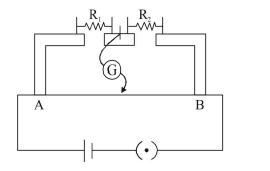
$$\frac{R_1}{R_2} = \frac{l_1}{100 - l_1}$$
Given initial null point $$l_1 = 40\text{ cm}$$: $$\frac{R_1}{R_2} = \frac{40}{100 - 40} = \frac{40}{60} = \frac{2}{3} \implies R_2 = 1.5R_1$$
Case 2: $$10\ \Omega$$ connected in series with $$R_1$$ shifts the null point to $$l_2 = 40 + 10 = 50\text{ cm}$$
$$\frac{R_1 + 10}{R_2} = \frac{50}{100 - 50} = \frac{50}{50} = 1 \implies R_1 + 10 = R_2$$
Substituting $$R_2 = 1.5R_1$$:
$$R_1 + 10 = 1.5R_1 \implies 0.5R_1 = 10 \implies R_1 = 20\ \Omega$$
$$R_2 = 1.5 \times 20 = 30\ \Omega$$
Case 3: Resistance $$X$$ in parallel with $$(R_1 + 10)\ \Omega$$ to restore the initial null point ($$40\text{ cm}$$)
Equivalent resistance of the left gap:
$$R_{\text{left}} = \frac{(R_1 + 10)X}{(R_1 + 10) + X} = \frac{(20 + 10)X}{(20 + 10) + X} = \frac{30X}{30 + X}$$
To restore the initial position, $$R_{\text{left}}$$ must equal the initial $$R_1$$:
$$R_{\text{left}} = R_1 \implies \frac{30X}{30 + X} = 20$$
$$30X = 20(30 + X) \implies 30X = 600 + 20X \implies 10X = 600 \implies X = 60\ \Omega$$
Was this solution helpful?
Create a FREE account and get:
_1.webp)

Educational materials for JEE preparation

Ask our AI anything

AI can make mistakes. Please verify important information.
AI can make mistakes. Please verify important information.


