
Join Our JEE Preparation Group
Prep with like-minded aspirants; Get access to free daily tests and study material.
Sign in
Please select an account to continue using cracku.in
↓ →
Join Our JEE Preparation Group
Prep with like-minded aspirants; Get access to free daily tests and study material.
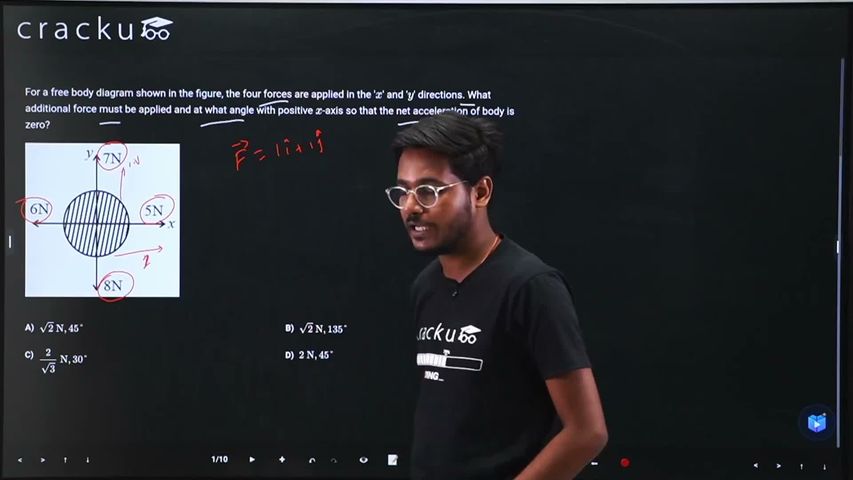
For a free body diagram shown in the figure, the four forces are applied in the '$$x$$' and '$$y$$' directions. What additional force must be applied and at what angle with positive $$x$$-axis so that the net acceleration of body is zero?
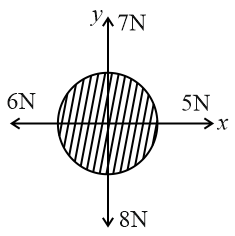
We need to find the additional force (both magnitude and direction) that must be applied to the body so that its net acceleration becomes zero, meaning the body remains in translational equilibrium.
From the free body diagram ,let's break down the given forces along the horizontal ($$x$$) and vertical ($$y$$) axes:
$$\Sigma F_x = 5\text{ N} - 6\text{ N} = -1\text{ N}$$
(This means there is a net force of $$1\text{ N}$$ pointing to the left).$$\Sigma F_y = 7\text{ N} - 8\text{ N} = -1\text{ N}$$
(This means there is a net force of $$1\text{ N}$$ pointing downward).Expressing the net existing force vector ($$\vec{F}_{\text{net}}$$):
$$\vec{F}_{\text{net}} = -1\hat{i} - 1\hat{j}$$
For the net acceleration of the body to be zero, the total vector sum of all forces must be zero:
$$\vec{F}_{\text{net}} + \vec{F}_{\text{add}} = 0 \implies \vec{F}_{\text{add}} = -\vec{F}_{\text{net}}$$
$$\vec{F}_{\text{add}} = -(-1\hat{i} - 1\hat{j}) = 1\hat{i} + 1\hat{j}$$
$$|\vec{F}_{\text{add}}| = \sqrt{(1)^2 + (1)^2} = \sqrt{2}\text{ N}$$
$$\tan \theta = \frac{F_y}{F_x} = \frac{1}{1} = 1$$
Since both the $$x$$ and $$y$$ components of our additional force are positive, the vector lies in the first quadrant:$$\theta = \tan^{-1}(1) = 45^\circ$$
The additional force that must be applied is $$\sqrt{2}\text{ N}$$ at an angle of $$45^\circ$$ with the positive $$x$$-axis (Option A).
Was this solution helpful?
Click on the Email ☝️ to Watch the Video Solution
Create a FREE account and get:
_1.webp)

Educational materials for JEE preparation

Ask our AI anything

AI can make mistakes. Please verify important information.
AI can make mistakes. Please verify important information.
