
Join Our JEE Preparation Group
Prep with like-minded aspirants; Get access to free daily tests and study material.
Sign in
Please select an account to continue using cracku.in
↓ →
Join Our JEE Preparation Group
Prep with like-minded aspirants; Get access to free daily tests and study material.
A constant power delivering machine has towed a box, which was initially at rest, along a horizontal straight line. The distance moved by the box in time $$t$$ is proportional to:
We are given that a machine delivers constant power ($$P$$) to tow a box along a horizontal straight line. The box starts from rest (initial velocity $$v = 0$$ at time $$t = 0$$).
Power is defined as the product of force ($$F$$) and instantaneous velocity ($$v$$):
$$P = F \cdot v = \text{Constant}$$
Using Newton's Second Law ($$F = m \cdot a$$) and expressing acceleration as the time derivative of velocity ($$a = \frac{dv}{dt}$$), we write:
$$P = \left( m \cdot \frac{dv}{dt} \right) \cdot v$$
Separate the variables to set up the integration with respect to velocity and time:
$$v \cdot dv = \left( \frac{P}{m} \right) \cdot dt$$
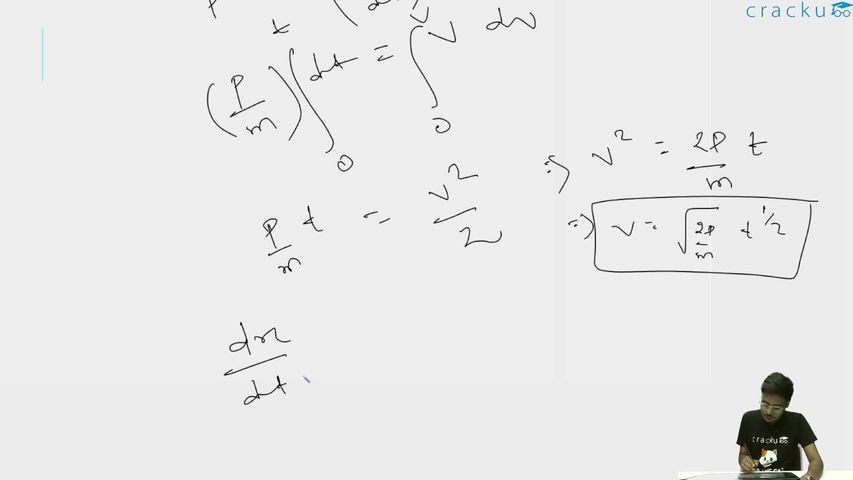
Integrating both sides from rest ($$0$$ to $$v$$) over the time interval ($$0$$ to $$t$$):
$$\int_{0}^{v} v \cdot dv = \frac{P}{m} \int_{0}^{t} dt$$
$$\frac{v^2}{2} = \frac{P}{m} \cdot t$$
$$v = \sqrt{\frac{2P}{m}} \cdot t^{1/2}$$
Velocity is defined as the rate of change of displacement or distance ($$v = \frac{ds}{dt}$$). Substituting this in gives:
$$\frac{ds}{dt} = \sqrt{\frac{2P}{m}} \cdot t^{1/2}$$
$$ds = \sqrt{\frac{2P}{m}} \cdot t^{1/2} \cdot dt$$
Integrating both sides to find the total distance covered ($$s$$):
$$\int_{0}^{s} ds = \sqrt{\frac{2P}{m}} \int_{0}^{t} t^{1/2} \cdot dt$$
$$s = \sqrt{\frac{2P}{m}} \cdot \left( \frac{t^{3/2}}{3/2} \right)$$
$$s = \frac{2}{3} \sqrt{\frac{2P}{m}} \cdot t^{3/2}$$
Since the values for power ($$P$$) and mass ($$m$$) remain completely constant, the distance is directly proportional to time raised to the power of $$\frac{3}{2}$$:
$$s \propto t^{3/2}$$
Concept Check: Because the power input is uniformly continuous, the kinetic energy of the box increases linearly with time ($$K \propto t$$). Since kinetic energy is proportional to the square of velocity ($$v^2$$), the velocity scales as $$t^{1/2}$$, which integrates directly into a distance scaling factor of $$t^{3/2}$$.
Correct Option Key: Option B (t3/2)
Was this solution helpful?
Click on the Email ☝️ to Watch the Video Solution
_1.webp)

Educational materials for JEE preparation

Ask our AI anything

AI can make mistakes. Please verify important information.
AI can make mistakes. Please verify important information.