
Join Our JEE Preparation Group
Prep with like-minded aspirants; Get access to free daily tests and study material.
Sign in
Please select an account to continue using cracku.in
↓ →
Join Our JEE Preparation Group
Prep with like-minded aspirants; Get access to free daily tests and study material.
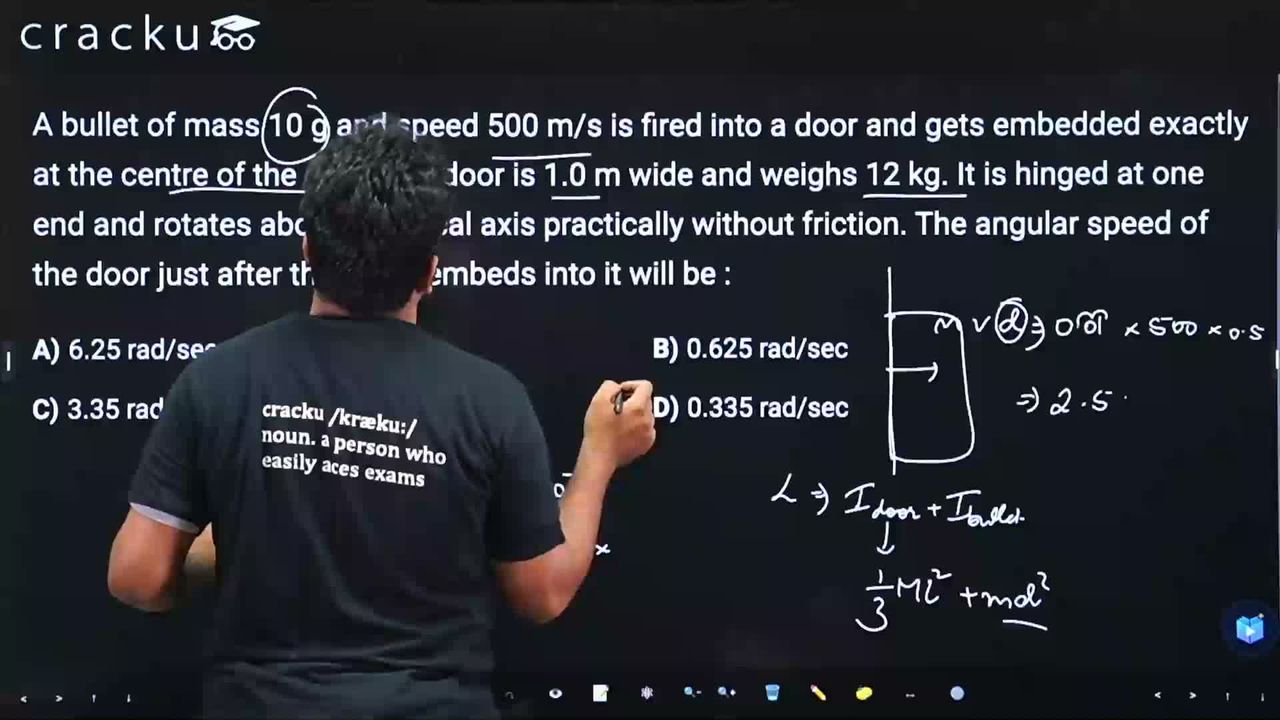
A bullet of mass 10 g and speed 500 m/s is fired into a door and gets embedded exactly at the centre of the door. The door is 1.0 m wide and weighs 12 kg. It is hinged at one end and rotates about a vertical axis practically without friction. The angular speed of the door just after the bullet embeds into it will be :
To solve this problem, we need to find the angular speed of the door just after a bullet embeds into its center. The bullet has a mass of 10 g and a speed of 500 m/s. The door is 1.0 m wide, has a mass of 12 kg, and is hinged at one end. Since the system rotates without friction, we can use the conservation of angular momentum about the hinge because there are no external torques acting on the system.
First, convert the mass of the bullet to kilograms. The mass is 10 g, which is $$ 10 \text{g} = \frac{10}{1000} \text{kg} = 0.01 \text{kg} $$.
The bullet embeds at the center of the door. The door is 1.0 m wide, so the distance from the hinge to the center is half of that: $$ d = \frac{1.0}{2} \text{m} = 0.5 \text{m} $$.
The initial angular momentum of the system is due only to the bullet because the door is initially at rest. The angular momentum of a moving object is given by the product of its linear momentum and the perpendicular distance from the axis of rotation. Since the bullet is moving perpendicular to the door and hits at a distance of 0.5 m from the hinge, the initial angular momentum is: $$ L_{\text{initial}} = m_b \times v_b \times d $$ where $$ m_b = 0.01 \text{kg} $$, $$ v_b = 500 \text{m/s} $$, and $$ d = 0.5 \text{m} $$. Substituting the values: $$ L_{\text{initial}} = 0.01 \times 500 \times 0.5 = 0.01 \times 250 = 2.5 \text{kg} \cdot \text{m}^2 / \text{s} $$.
After the bullet embeds, the door and bullet rotate together as a single system with angular speed $$ \omega $$. The total moment of inertia of the system about the hinge must be calculated. The door can be approximated as a thin rod rotating about one end. The moment of inertia for a rod of mass $$ M $$ and length $$ L $$ about one end is $$ \frac{1}{3} M L^2 $$. Here, $$ M = 12 \text{kg} $$ and $$ L = 1.0 \text{m} $$, so: $$ I_{\text{door}} = \frac{1}{3} \times 12 \times (1.0)^2 = \frac{1}{3} \times 12 \times 1 = 4 \text{kg} \cdot \text{m}^2 $$.
The bullet is a point mass embedded at a distance of 0.5 m from the hinge. Its moment of inertia is: $$ I_{\text{bullet}} = m_b \times d^2 = 0.01 \times (0.5)^2 = 0.01 \times 0.25 = 0.0025 \text{kg} \cdot \text{m}^2 $$.
The total moment of inertia of the system is the sum: $$ I_{\text{total}} = I_{\text{door}} + I_{\text{bullet}} = 4 + 0.0025 = 4.0025 \text{kg} \cdot \text{m}^2 $$.
The final angular momentum is given by: $$ L_{\text{final}} = I_{\text{total}} \times \omega $$.
By conservation of angular momentum, initial angular momentum equals final angular momentum: $$ L_{\text{initial}} = L_{\text{final}} $$ $$ 2.5 = 4.0025 \times \omega $$.
Solving for $$ \omega $$: $$ \omega = \frac{2.5}{4.0025} $$.
To simplify, note that $$ 4.0025 = \frac{1601}{400} $$ because $$ 4.0025 = 4 + \frac{25}{10000} = 4 + \frac{1}{400} = \frac{1600}{400} + \frac{1}{400} = \frac{1601}{400} $$. Also, $$ 2.5 = \frac{5}{2} $$. So: $$ \omega = \frac{\frac{5}{2}}{\frac{1601}{400}} = \frac{5}{2} \times \frac{400}{1601} = \frac{5 \times 400}{2 \times 1601} = \frac{2000}{3202} = \frac{1000}{1601} \approx 0.6246 \text{rad/s} $$.
This value is approximately 0.625 rad/s. Comparing with the options, 0.625 rad/s corresponds to option B. Additionally, the moment of inertia of the bullet is very small compared to that of the door (0.0025 kg·m² vs 4 kg·m²), so neglecting it gives $$ I_{\text{total}} \approx 4 \text{kg} \cdot \text{m}^2 $$ and $$ \omega = \frac{2.5}{4} = 0.625 \text{rad/s} $$, which matches exactly.
Hence, the correct answer is Option B.
Was this solution helpful?
Click on the Email ☝️ to Watch the Video Solution
Create a FREE account and get:
_1.webp)

Educational materials for JEE preparation

Ask our AI anything

AI can make mistakes. Please verify important information.
AI can make mistakes. Please verify important information.


