
Join Our JEE Preparation Group
Prep with like-minded aspirants; Get access to free daily tests and study material.
Sign in
Please select an account to continue using cracku.in
↓ →
Join Our JEE Preparation Group
Prep with like-minded aspirants; Get access to free daily tests and study material.
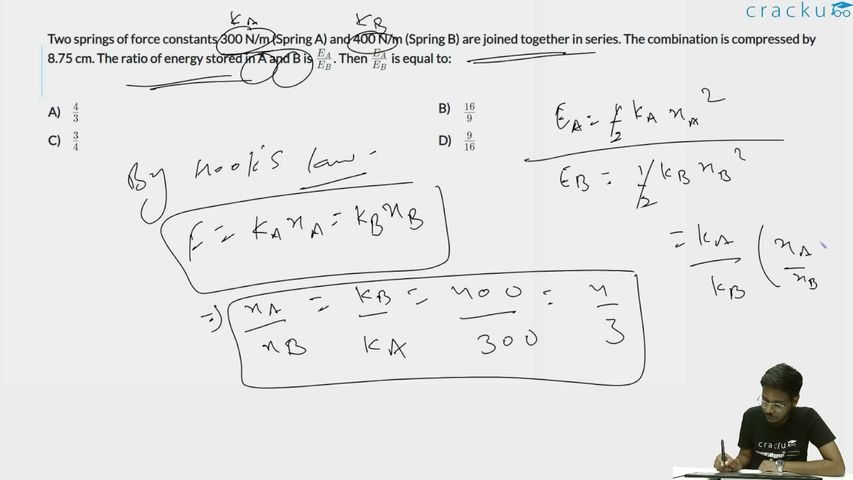
Two springs of force constants 300 N/m (Spring A) and 400 N/m (Spring B) are joined together in series. The combination is compressed by 8.75 cm. The ratio of energy stored in A and B is $$\frac{E_A}{E_B}$$. Then $$\frac{E_A}{E_B}$$ is equal to:
Two springs, A and B, with force constants $$k_A = 300 \text{N/m}$$ and $$k_B = 400 \text{N/m}$$, are connected in series. The total compression of the combination is $$8.75 \text{cm}$$, which is $$8.75 / 100 = 0.0875 \text{m}$$. We need to find the ratio of energy stored in spring A to that in spring B, $$E_A / E_B$$.
For springs in series, the same force $$F$$ acts through both springs, but the displacements are different. Let $$x_A$$ be the compression in spring A and $$x_B$$ be the compression in spring B. The total compression is the sum: $$x_A + x_B = 0.0875 \text{m}$$.
By Hooke's law, the force is given by $$F = k_A x_A = k_B x_B$$. Substituting the values, we get:
$$300 x_A = 400 x_B$$
Simplifying this equation:
$$300 x_A = 400 x_B \implies \frac{x_A}{x_B} = \frac{400}{300} = \frac{4}{3}$$
So, $$x_A = \frac{4}{3} x_B$$. Now substitute this into the total compression equation:
$$x_A + x_B = 0.0875 \implies \frac{4}{3} x_B + x_B = 0.0875 \implies \frac{7}{3} x_B = 0.0875$$
Solving for $$x_B$$:
$$x_B = 0.0875 \times \frac{3}{7}$$
Note that $$0.0875 = \frac{7}{80}$$ (since $$7 \div 80 = 0.0875$$). So:
$$x_B = \frac{7}{80} \times \frac{3}{7} = \frac{3}{80} \text{m}$$
Then, $$x_A = \frac{4}{3} x_B = \frac{4}{3} \times \frac{3}{80} = \frac{4}{80} = \frac{1}{20} \text{m}$$.
The energy stored in a spring is given by $$E = \frac{1}{2} k x^2$$. So for spring A:
$$E_A = \frac{1}{2} \times 300 \times \left( \frac{1}{20} \right)^2 = \frac{1}{2} \times 300 \times \frac{1}{400} = \frac{300}{800} = \frac{3}{8} \text{J}$$
For spring B:
$$E_B = \frac{1}{2} \times 400 \times \left( \frac{3}{80} \right)^2 = \frac{1}{2} \times 400 \times \frac{9}{6400} = \frac{3600}{12800} = \frac{9}{32} \text{J}$$
The ratio $$E_A / E_B$$ is:
$$\frac{E_A}{E_B} = \frac{3/8}{9/32} = \frac{3}{8} \times \frac{32}{9} = \frac{3 \times 32}{8 \times 9} = \frac{96}{72} = \frac{4}{3}$$
Alternatively, using the formula for the energy ratio:
$$\frac{E_A}{E_B} = \frac{k_A}{k_B} \times \left( \frac{x_A}{x_B} \right)^2$$
We have $$k_A / k_B = 300 / 400 = 3/4$$ and $$x_A / x_B = 4/3$$, so:
$$\frac{E_A}{E_B} = \frac{3}{4} \times \left( \frac{4}{3} \right)^2 = \frac{3}{4} \times \frac{16}{9} = \frac{48}{36} = \frac{4}{3}$$
Both methods give the same result. Comparing with the options, $$\frac{4}{3}$$ corresponds to option A.
Hence, the correct answer is Option A.
Was this solution helpful?
Click on the Email ☝️ to Watch the Video Solution
Create a FREE account and get:
_1.webp)

Educational materials for JEE preparation

Ask our AI anything

AI can make mistakes. Please verify important information.
AI can make mistakes. Please verify important information.


