
Join Our JEE Preparation Group
Prep with like-minded aspirants; Get access to free daily tests and study material.
Sign in
Please select an account to continue using cracku.in
↓ →
Join Our JEE Preparation Group
Prep with like-minded aspirants; Get access to free daily tests and study material.
A balloon has mass of 10 g in air. The air escapes from the balloon at a uniform rate with velocity 4.5 cm s$$^{-1}$$. If the balloon shrinks in 5 s completely. Then, the average force acting on that balloon will be (in dyne).
We need to determine the average force acting on a balloon as air escapes from it completely.
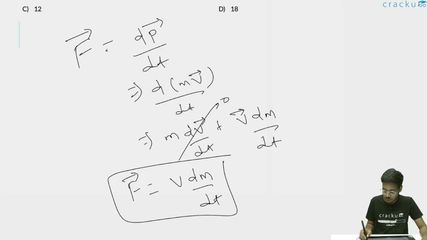
According to Newton's second law of motion, force is equal to the rate of change of momentum. For a variable mass system where a substance is ejected at a constant relative velocity, the thrust force ($$F$$) is given by the formula:
$$F = v \cdot \frac{dm}{dt}$$
Since the problem specifies CGS units (grams, centimeters, seconds, and dynes), we can keep all values in their current forms:
The air escapes at a uniform rate, meaning the mass decreases from $$10\text{ g}$$ to $$0\text{ g}$$ over an interval of $$5\text{ s}$$:
$$\frac{dm}{dt} = \frac{\Delta m}{\Delta t} = \frac{10\text{ g}}{5\text{ s}} = 2\text{ g s}^{-1}$$
Substitute the velocity and the calculated rate of mass loss back into the force equation:
$$F = 4.5\text{ cm s}^{-1} \times 2\text{ g s}^{-1}$$
$$F = 9\text{ g cm s}^{-2} = 9\text{ dyne}$$
Therefore, the average force acting on the balloon is 9 dyne, which corresponds to Option B.
Click on the Email ☝️ to Watch the Video Solution
Create a FREE account and get:
_1.webp)

Educational materials for JEE preparation

Ask our AI anything

AI can make mistakes. Please verify important information.
AI can make mistakes. Please verify important information.


