
Join Our JEE Preparation Group
Prep with like-minded aspirants; Get access to free daily tests and study material.
Sign in
Please select an account to continue using cracku.in
↓ →
Join Our JEE Preparation Group
Prep with like-minded aspirants; Get access to free daily tests and study material.
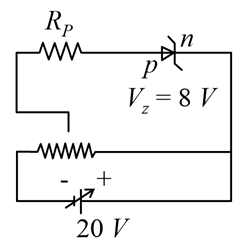
A zener diode having zener voltage 8 V and power dissipation rating of 0.5 W is connected across a potential divider arranged with maximum potential drop across zener diode as shown in the diagram. The value of protective resistance $$R_p$$ is ___ $$\Omega$$.
Correct Answer: 192
We need to determine the value of the protective resistance $$R_p$$ connected in series with a Zener diode under the maximum potential drop arrangement.
The maximum power dissipation inside a Zener diode occurs when it carries its peak breakdown current while maintaining its rated Zener voltage. The relation is expressed as:
$$P_{\text{max}} = V_z \times I_{z\text{,max}}$$
Isolating the maximum current ($$I_{z\text{,max}}$$):
$$I_{z\text{,max}} = \frac{P_{\text{max}}}{V_z} = \frac{0.5\text{ W}}{8\text{ V}} = \frac{1}{16}\text{ A} = 0.0625\text{ A}$$
When the potential divider is set such that the maximum potential drop is applied across the Zener system, the Zener diode operates in its breakdown region, fixing the voltage across itself and any parallel load at exactly $$V_z = 8\text{ V}$$.
By applying Kirchhoff's Voltage Law (KVL) around the main input loop, the voltage drop across the series protective resistance ($$R_p$$) is the remaining portion of the supply voltage:
$$V_{Rp} = V_s - V_z$$
$$V_{Rp} = 20\text{ V} - 8\text{ V} = 12\text{ V}$$
To ensure the Zener diode is safely protected and does not burn out under maximum potential conditions, the series resistor must limit the loop current to exactly the maximum safe Zener current ($$I_{z\text{,max}}$$). Using Ohm's law:
$$R_p = \frac{V_{Rp}}{I_{z\text{,max}}}$$
Substituting the values calculated above:
$$R_p = \frac{12\text{ V}}{\left(\frac{1}{16}\text{ A}\right)} = 12 \times 16 = 192\ \Omega$$
Final Answer: $$192$$
Was this solution helpful?
Click on the Email ☝️ to Watch the Video Solution
Create a FREE account and get:
_1.webp)

Educational materials for JEE preparation

Ask our AI anything

AI can make mistakes. Please verify important information.
AI can make mistakes. Please verify important information.
