Join Our JEE Preparation Group
Prep with like-minded aspirants; Get access to free daily tests and study material.
Sign in
Please select an account to continue using cracku.in
↓ →
Join Our JEE Preparation Group
Prep with like-minded aspirants; Get access to free daily tests and study material.
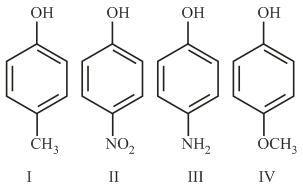
To determine the increasing order of boiling points of the given substituted phenols, we compare the intermolecular forces present in each compound, particularly hydrogen bonding and dipole-dipole interactions.
All four compounds contain a phenolic $$-OH$$ group capable of forming intermolecular hydrogen bonds. Therefore, differences in boiling point arise mainly from the nature of the substituent attached to the benzene ring, which influences the strength of these intermolecular interactions.
In $$p$$-cresol (I), the $$-CH_3$$ group is an electron-donating substituent through the $$+I$$ effect. It slightly decreases the acidity of the phenolic $$-OH$$ group and weakens intermolecular hydrogen bonding, resulting in the lowest boiling point among the given compounds.
In $$p$$-methoxyphenol (IV), the $$-OCH_3$$ group donates electrons through the $$+R$$ effect. Although it enhances molecular polarity to some extent, its overall contribution to intermolecular attraction is greater than that of the methyl group, giving it a boiling point slightly higher than $$p$$-cresol.
In $$p$$-nitrophenol (II), the strongly electron-withdrawing $$-NO_2$$ group exerts both $$-I$$ and $$-R$$ effects, increasing the acidity of the phenolic $$-OH$$ group and strengthening intermolecular hydrogen bonding. The high polarity of the nitro group also enhances dipole-dipole interactions, leading to a comparatively higher boiling point.
In $$p$$-aminophenol (III), the $$-NH_2$$ group itself can participate in intermolecular hydrogen bonding in addition to the phenolic $$-OH$$ group. The presence of both hydrogen bond donor and acceptor sites creates an extensive hydrogen-bonding network, resulting in the highest boiling point among the four compounds.
Therefore, the increasing order of boiling points is
$$\boxed{\text{I} < \text{IV} < \text{II} < \text{III}}$$
which corresponds to the option B.
Was this solution helpful?
Create a FREE account and get:
_1.webp)

Educational materials for JEE preparation

Ask our AI anything

AI can make mistakes. Please verify important information.
AI can make mistakes. Please verify important information.