
Join Our JEE Preparation Group
Prep with like-minded aspirants; Get access to free daily tests and study material.
Sign in
Please select an account to continue using cracku.in
↓ →
Join Our JEE Preparation Group
Prep with like-minded aspirants; Get access to free daily tests and study material.
An object is placed at a distance of 12 cm from a convex lens. A convex mirror of focal length 15 cm is placed on another side of the lens at 8 cm as shown in the figure. The image of the object coincides with the object.
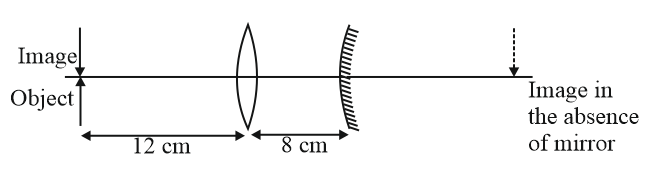
When the convex mirror is removed, a real and inverted image is formed at a position. The distance of the image from the object will be _________ cm
Correct Answer: 50
We need to find the total distance between the object and its final real image when the convex mirror is removed from the system.
We are given that the final image of the object coincides with the object itself. This means light rays traveling from the object pass through the convex lens, strike the convex mirror, and trace their paths exactly back to the object.
For light rays to retrace their path after reflecting off a convex mirror, they must hit the mirror surface normally (perpendicularly). This happens only if the refracted rays from the lens are traveling toward the center of curvature ($C$) of the convex mirror.
$$R = 2 \times f_m = 2 \times 15\text{ cm} = 30\text{ cm}$$
Therefore, in the absence of the mirror, the lens would form a virtual image at the center of curvature of the mirror. Let's calculate this position ($v$) relative to the lens:
$$\text{Distance from lens to mirror} = 8\text{ cm}$$
$$\text{Distance from mirror to } C = 30\text{ cm}$$
$$v = 8\text{ cm} + 30\text{ cm} = 38\text{ cm}$$
So, the image distance for the lens is $$v = +38\text{ cm}$$.
When the convex mirror is removed, the light rays simply continue along their path unobstructed and converge to form a real image at that very same position ($v = 38\text{ cm}$) from the lens.
Let's map out the positions of the key elements along the principal axis:
The total horizontal distance ($D$) from the object to its final real image is the sum of the object distance and the image distance relative to the lens:
$$D = \text{Distance from Object to Lens} + \text{Distance from Lens to Image}$$
$$D = 12\text{ cm} + 38\text{ cm} = 50\text{ cm}$$
Final Answer: 50
Was this solution helpful?
Create a FREE account and get:
_1.webp)

Educational materials for JEE preparation

Ask our AI anything

AI can make mistakes. Please verify important information.
AI can make mistakes. Please verify important information.
