Join Our JEE Preparation Group
Prep with like-minded aspirants; Get access to free daily tests and study material.
Sign in
Please select an account to continue using cracku.in
↓ →
Join Our JEE Preparation Group
Prep with like-minded aspirants; Get access to free daily tests and study material.
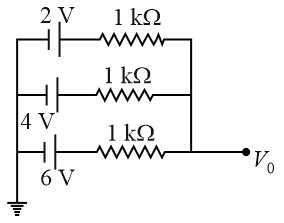
We need to determine the output voltage $$V_0$$ for the given parallel combination of practical voltage sources (batteries with internal resistances).
From the circuit diagram,we have three branches connected in parallel to the common output node $$V_0$$:
All the negative terminals of the batteries are tied together to the ground ($$0\text{ V}$$).
Millman's Theorem states that when multiple voltage sources are connected in parallel, the equivalent voltage ($$V_0$$) across the common terminals is given by:
$$V_0 = \frac{\frac{E_1}{r_1} + \frac{E_2}{r_2} + \frac{E_3}{r_3}}{\frac{1}{r_1} + \frac{1}{r_2} + \frac{1}{r_3}}$$
Since all the internal resistances are equal ($$r_1 = r_2 = r_3 = 1\text{ k}\Omega$$), the expression simplifies directly to the arithmetic mean of the voltages:
$$V_0 = \frac{\frac{2}{1} + \frac{4}{1} + \frac{6}{1}}{\frac{1}{1} + \frac{1}{1} + \frac{1}{1}}$$
$$V_0 = \frac{2 + 4 + 6}{1 + 1 + 1}$$
$$V_0 = \frac{12}{3} = 4\text{ V}$$
The value of $$V_0$$ is 4 V.
Was this solution helpful?
Click on the Email ☝️ to Watch the Video Solution
Create a FREE account and get:
_1.webp)

Educational materials for JEE preparation

Ask our AI anything

AI can make mistakes. Please verify important information.
AI can make mistakes. Please verify important information.