
Join Our JEE Preparation Group
Prep with like-minded aspirants; Get access to free daily tests and study material.
Sign in
Please select an account to continue using cracku.in
↓ →
Join Our JEE Preparation Group
Prep with like-minded aspirants; Get access to free daily tests and study material.
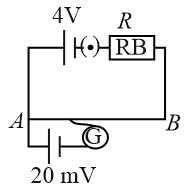
As shown in the figure, a potentiometer wire of resistance 20 $$\Omega$$ and length 300 cm is connected with resistance box (R.B.) and a standard cell of emf 4 V. For a resistance 'R' of resistance box introduced into the circuit, the null point for a cell of 20 mV is found to be 60 cm. The value of 'R' is _____ $$\Omega$$.
Correct Answer: 780
We need to determine the value of the resistance $$R$$ introduced in the resistance box (R.B.) of the potentiometer circuit so that a cell of EMF $$20\text{ mV}$$ balances at a length of $$60\text{ cm}$$.
The potential difference balanced across the length $$l$$ of the wire is directly proportional to that length. The balancing condition is given by:
$$E = k \cdot l$$
Where $$k$$ is the potential gradient (potential drop per unit length) of the potentiometer wire, defined as:
$$k = \frac{V_w}{L}$$
Here, $$V_w$$ is the total voltage drop across the entire potentiometer wire.
Using the balancing condition for the secondary cell:
$$20 \times 10^{-3}\text{ V} = k \times 60\text{ cm}$$
$$k = \frac{20 \times 10^{-3}\text{ V}}{60\text{ cm}} = \frac{1}{3000}\text{ V cm}^{-1}$$
Now, calculate the total voltage drop ($$V_w$$) across the entire $$300\text{ cm}$$ wire:
$$V_w = k \times L = \frac{1}{3000}\text{ V cm}^{-1} \times 300\text{ cm} = 0.1\text{ V}$$
The main primary circuit forms a series network consisting of the standard cell ($$4\text{ V}$$), the resistance box ($$R$$), and the potentiometer wire ($$R_w = 20\ \Omega$$). Using the voltage divider rule, the voltage drop across the wire is:
$$V_w = V_s \times \left( \frac{R_w}{R + R_w} \right)$$
Substitute the known values into the equation:
$$0.1 = 4 \times \left( \frac{20}{R + 20} \right)$$
$$0.1 = \frac{80}{R + 20}$$
Cross-multiplying to solve for $$R$$:
$$0.1(R + 20) = 80$$
$$R + 20 = \frac{80}{0.1}$$
$$R + 20 = 800$$
$$R = 800 - 20 = 780\ \Omega$$
The required resistance to be introduced in the resistance box is 780 $$\Omega$$.
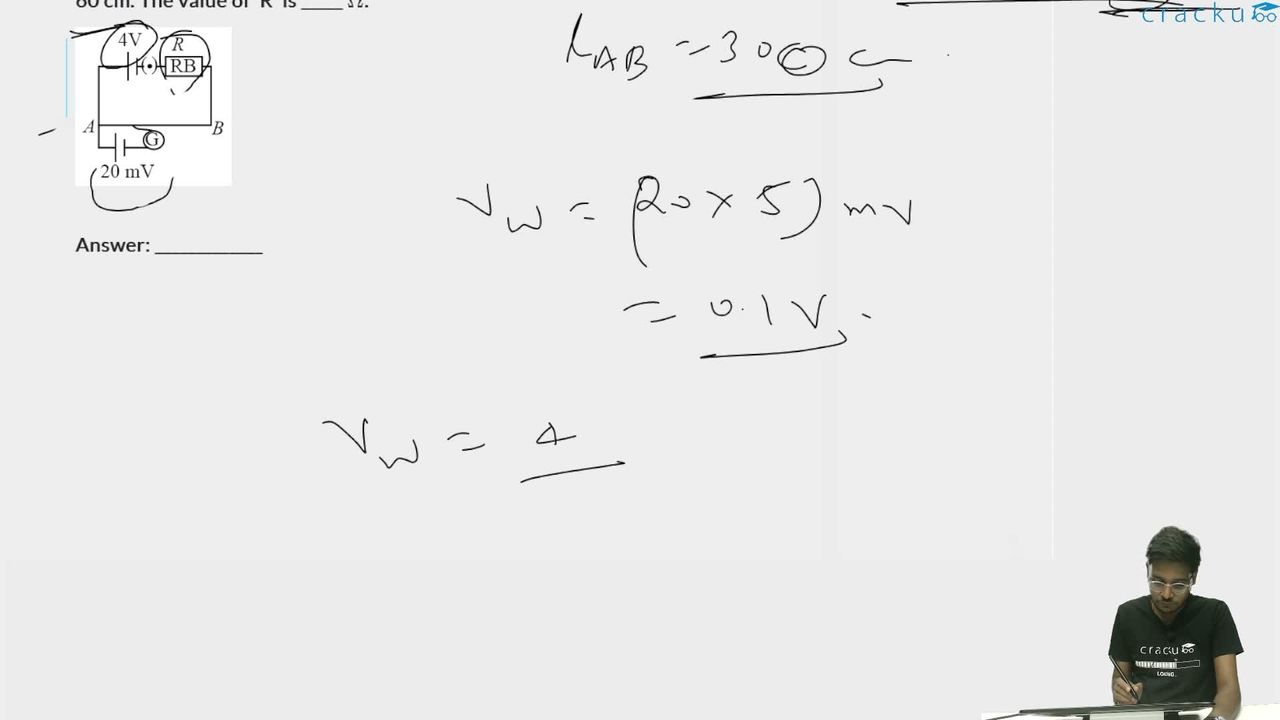
Click on the Email ☝️ to Watch the Video Solution
Create a FREE account and get:
_1.webp)

Educational materials for JEE preparation

Ask our AI anything

AI can make mistakes. Please verify important information.
AI can make mistakes. Please verify important information.


