
Join Our JEE Preparation Group
Prep with like-minded aspirants; Get access to free daily tests and study material.
Sign in
Please select an account to continue using cracku.in
↓ →
Join Our JEE Preparation Group
Prep with like-minded aspirants; Get access to free daily tests and study material.
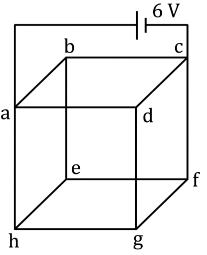
Twelve wires each having resistance 2Ω are joined to form a cube. A battery of emf 6 V is joined across point a and c. The voltage difference between e and f is ______ V.
Correct Answer: 1
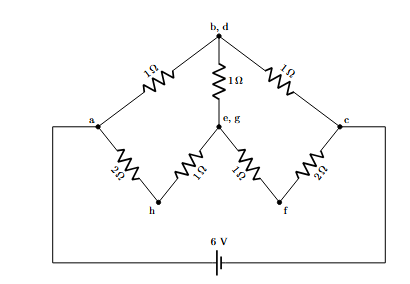
battery is connected across a and c
so points b,d and e,g at middle due to symmetry
which means b,d are at same potential , similarly points e,g are at same potential
so we can draw the simplified equivalent circuit as above
apply Kirchhoff's Current Law (KCL) at each of the unknown nodes. Let us define the potentials at the various nodes.
The battery applies a $$ 6\text{ V} $$ potential difference across the circuit. Let us set the negative terminal node $$ c $$ to $$ 0\text{ V} $$ as our reference.
$$ V_a = 6\text{ V} $$
$$ V_c = 0\text{ V} $$
Let the potentials at the remaining nodes be:
$$ V_{bd} $$ for the combined node $$ (b, d) $$
$$ V_{eg} $$ for the combined node $$ (e, g) $$
$$ V_h $$ for node $$ h $$
$$ V_f $$ for node $$ f $$
Now, we set up KCL equations for each of these nodes (sum of currents leaving the node equals zero).
1. Node $$ (b, d) $$:
It connects to $$ a $$ ($$ 1\,\Omega $$), $$ c $$ ($$ 1\,\Omega $$), and $$ (e, g) $$ ($$ 1\,\Omega $$).
$$ \frac{V_{bd} - 6}{1} + \frac{V_{bd} - 0}{1} + \frac{V_{bd} - V_{eg}}{1} = 0 $$
$$ 3V_{bd} - V_{eg} = 6 \quad \text{--- (Equation 1)} $$
2. Node $$ h $$:
It connects to $$ a $$ ($$ 2\,\Omega $$) and $$ (e, g) $$ ($$ 1\,\Omega $$).
$$ \frac{V_h - 6}{2} + \frac{V_h - V_{eg}}{1} = 0 $$
Multiply by 2 to clear the denominator:
$$ V_h - 6 + 2V_h - 2V_{eg} = 0 $$
$$ 3V_h - 2V_{eg} = 6 $$
$$ V_h = 2 + \frac{2}{3}V_{eg} \quad \text{--- (Equation 2)} $$
3. Node $$ f $$:
It connects to $$ (e, g) $$ ($$ 1\,\Omega $$) and $$ c $$ ($$ 2\,\Omega $$).
$$ \frac{V_f - V_{eg}}{1} + \frac{V_f - 0}{2} = 0 $$
Multiply by 2:
$$ 2V_f - 2V_{eg} + V_f = 0 $$
$$ 3V_f = 2V_{eg} $$
$$ V_f = \frac{2}{3}V_{eg} \quad \text{--- (Equation 3)} $$
4. Node $$ (e, g) $$:
It connects to $$ (b, d) $$ ($$ 1\,\Omega $$), $$ h $$ ($$ 1\,\Omega $$), and $$ f $$ ($$ 1\,\Omega $$).
$$ \frac{V_{eg} - V_{bd}}{1} + \frac{V_{eg} - V_h}{1} + \frac{V_{eg} - V_f}{1} = 0 $$
$$ 3V_{eg} - V_{bd} - V_h - V_f = 0 \quad \text{--- (Equation 4)} $$
Substitute Equations 2 and 3 into Equation 4:
$$ 3V_{eg} - V_{bd} - \left(2 + \frac{2}{3}V_{eg}\right) - \left(\frac{2}{3}V_{eg}\right) = 0 $$
$$ 3V_{eg} - \frac{4}{3}V_{eg} - V_{bd} - 2 = 0 $$
$$ \frac{5}{3}V_{eg} - V_{bd} = 2 $$
$$ V_{bd} = \frac{5}{3}V_{eg} - 2 $$
Now, substitute this expression for $$ V_{bd} $$ back into Equation 1:
$$ 3\left(\frac{5}{3}V_{eg} - 2\right) - V_{eg} = 6 $$
$$ 5V_{eg} - 6 - V_{eg} = 6 $$
$$ 4V_{eg} = 12 $$
$$ V_{eg} = 3\text{ V} $$
Since node $$ e $$ is part of the combined node $$ (e, g) $$, its potential is:
$$ V_e = 3\text{ V} $$
Now, substitute $$ V_{eg} $$ into Equation 3 to find the potential at node $$ f $$:
$$ V_f = \frac{2}{3}(3) $$
$$ V_f = 2\text{ V} $$
The voltage difference between nodes $$ e $$ and $$ f $$ is:
$$ V_e - V_f = 3\text{ V} - 2\text{ V} = 1\text{ V} $$
Was this solution helpful?
Click on the Email ☝️ to Watch the Video Solution
Create a FREE account and get:
_1.webp)

Educational materials for JEE preparation

Ask our AI anything

AI can make mistakes. Please verify important information.
AI can make mistakes. Please verify important information.
