
Join Our JEE Preparation Group
Prep with like-minded aspirants; Get access to free daily tests and study material.
Sign in
Please select an account to continue using cracku.in
↓ →
Join Our JEE Preparation Group
Prep with like-minded aspirants; Get access to free daily tests and study material.
Two circuits are shown in figure (a) and (b). At a frequency of _________ rad s$$^{-1}$$ the average power dissipated in one cycle will be the same in both the circuits.
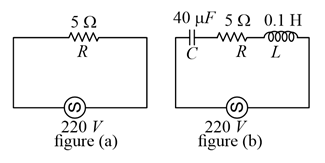
Correct Answer: 500
We need to find the angular frequency ($$\omega$$) at which the average power dissipated per cycle is exactly the same for both alternating current (AC) circuits shown in the diagram.
From the problem :
The average power dissipated ($$P_{\text{avg}}$$) in an AC circuit depends on the root-mean-square voltage ($$V_{\text{rms}}$$), total impedance ($$Z$$), and the power factor ($$\cos\phi$$):
$$P_{\text{avg}} = V_{\text{rms}} I_{\text{rms}} \cos\phi = V_{\text{rms}} \left(\frac{V_{\text{rms}}}{Z}\right) \left(\frac{R}{Z}\right) = \frac{V_{\text{rms}}^2 R}{Z^2}$$
$$P_a = \frac{V_{\text{rms}}^2}{R}$$
$$P_b = \frac{V_{\text{rms}}^2 R}{R^2 + (X_L - X_C)^2}$$
Setting the average power values equal to each other ($$P_a = P_b$$):
$$\frac{V_{\text{rms}}^2}{R} = \frac{V_{\text{rms}}^2 R}{R^2 + (X_L - X_C)^2}$$
Cancel out $$V_{\text{rms}}^2$$ and cross-multiply to solve:
$$R^2 + (X_L - X_C)^2 = R^2$$
$$(X_L - X_C)^2 = 0 \implies X_L = X_C$$
This shows that for the power to be identical, circuit (b) must be operating at its resonance frequency, where the inductive reactance matches the capacitive reactance.
Express the reactances in terms of angular frequency ($$\omega$$):
$$\omega L = \frac{1}{\omega C} \implies \omega^2 = \frac{1}{LC}$$
$$\omega = \frac{1}{\sqrt{LC}}$$
Substitute the given values of $$L$$ and $$C$$ into the formula:
$$\omega = \frac{1}{\sqrt{0.1 \times 40 \times 10^{-6}}} = \frac{1}{\sqrt{4 \times 10^{-6}}} = \frac{1}{2 \times 10^{-3}}$$
$$\omega = \frac{1000}{2} = 500\text{ rad s}^{-1}$$
The average power dissipated in one cycle will be the same in both circuits at an angular frequency of 500 $$\text{rad s}^{-1}$$.
Was this solution helpful?
Create a FREE account and get:
_1.webp)

Educational materials for JEE preparation

Ask our AI anything

AI can make mistakes. Please verify important information.
AI can make mistakes. Please verify important information.
