
Join Our JEE Preparation Group
Prep with like-minded aspirants; Get access to free daily tests and study material.
Sign in
Please select an account to continue using cracku.in
↓ →
Join Our JEE Preparation Group
Prep with like-minded aspirants; Get access to free daily tests and study material.
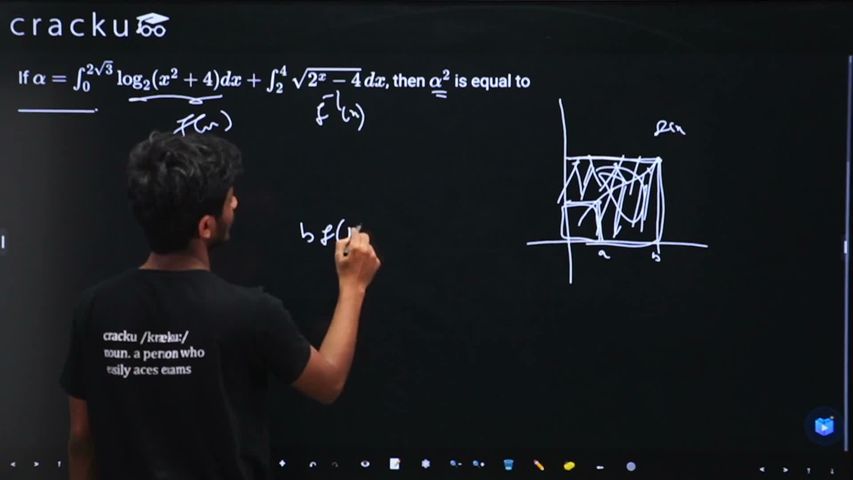
If $$\alpha = \int_0^{2\sqrt{3}} \log_2(x^2 + 4) dx + \int_2^4 \sqrt{2^x - 4} \, dx$$, then $$\alpha^2$$ is equal to __________.
Correct Answer: 192
Let us define a function $$f:\,[0,\;2\sqrt{3}] \rightarrow [2,\;4]$$ by
$$f(x)=\log_2\!\left(x^2+4\right)\,.$$
Step 1: Check that the limits match the image of the function.
At $$x=0$$ : $$f(0)=\log_2 4 = 2$$.
At $$x=2\sqrt{3}$$ : $$f(2\sqrt{3})=\log_2(12+4)=\log_2 16 = 4$$.
Hence $$f(x)$$ indeed maps $$x\in[0,\,2\sqrt{3}]$$ onto $$y\in[2,\,4]$$.
Step 2: Write its inverse.
Starting with $$y=f(x)=\log_2(x^2+4)$$, rewrite in exponential form:
$$2^{\,y}=x^2+4 \;\Longrightarrow\; x=\sqrt{2^{\,y}-4}.$$
Thus the inverse function is
$$f^{-1}(y)=\sqrt{2^{\,y}-4},\qquad y\in[2,\,4].$$
Step 3: Use the standard area identity for a function and its inverse.
For any continuous, strictly monotonic function $$f$$ whose inverse exists, the following holds:
$$\int_{a}^{b} f(x)\,dx + \int_{f(a)}^{f(b)} f^{-1}(y)\,dy = b\,f(b) - a\,f(a).$$
Step 4: Apply the identity to the given integrals.
Here $$a=0,\; b=2\sqrt{3},\; f(a)=2,\; f(b)=4.$$\newline
Therefore
$$\alpha = \int_{0}^{2\sqrt{3}} \log_2(x^2 + 4)\,dx \;+\; \int_{2}^{4} \sqrt{2^{\,x} - 4}\,dx$$
$$\phantom{\alpha}= b\,f(b) - a\,f(a)$$
$$\phantom{\alpha}= (2\sqrt{3})(4) - (0)(2)$$
$$\phantom{\alpha}= 8\sqrt{3}.$$
Step 5: Square the result.
$$\alpha^2 = (8\sqrt{3})^2 = 64 \times 3 = 192.$$
Hence the required value is 192.
Was this solution helpful?
Click on the Email ☝️ to Watch the Video Solution
Create a FREE account and get:
_1.webp)

Educational materials for JEE preparation

Ask our AI anything

AI can make mistakes. Please verify important information.
AI can make mistakes. Please verify important information.
