
Join Our JEE Preparation Group
Prep with like-minded aspirants; Get access to free daily tests and study material.
Sign in
Please select an account to continue using cracku.in
↓ →
Join Our JEE Preparation Group
Prep with like-minded aspirants; Get access to free daily tests and study material.
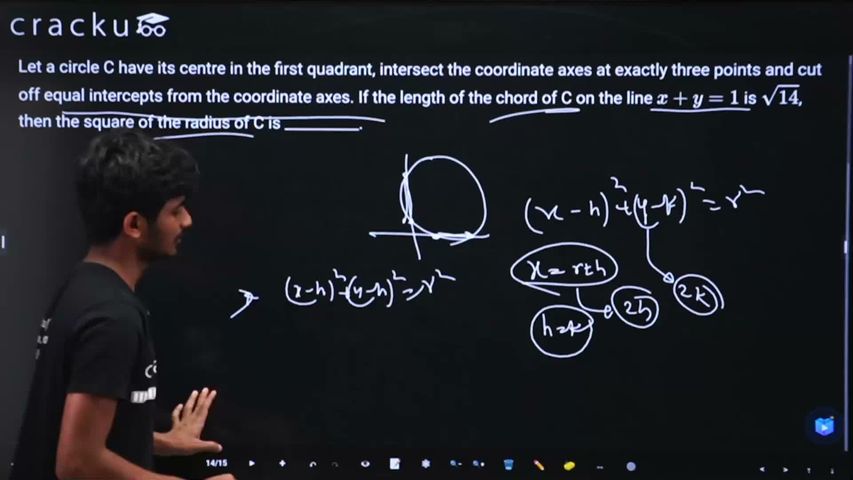
Let a circle C have its centre in the first quadrant, intersect the coordinate axes at exactly three points and cut off equal intercepts from the coordinate axes. If the length of the chord of C on the line $$x + y = 1$$ is $$\sqrt{14}$$, then the square of the radius of C is __________.
Correct Answer: 8
Let the circle be $$C$$ with centre $$O(h,k)$$ and radius $$r$$. As the centre lies in the first quadrant, $$h\gt 0,\,k\gt 0$$.
The circle intersects the coordinate axes in exactly three distinct points. A circle can meet one axis in at most two points. Hence, for a total of three points, one point must be common to both axes, i.e. the circle passes through the origin $$P(0,0)$$. Therefore two more points of intersection are $$Q(a,0)$$ on the $$x$$-axis and $$R(0,a)$$ on the $$y$$-axis, where the positive intercept length is $$a\gt 0$$.
Thus the circle passes through the three non-collinear points $$(0,0),\;(a,0),\;(0,a).$$ Its equation can be written in the general form $$x^{2}+y^{2}+2gx+2fy=0,$$ because the term $$c$$ is zero (the circle contains the origin).
Substituting $$Q(a,0)$$:
$$a^{2}+2ga=0\;\Longrightarrow\;g=-\dfrac{a}{2}.$$
Substituting $$R(0,a)$$:
$$a^{2}+2fa=0\;\Longrightarrow\;f=-\dfrac{a}{2}.$$
Hence the centre is $$O(-g,\,-f)=\left(\dfrac{a}{2},\dfrac{a}{2}\right).$$
The radius is the distance from $$O$$ to the origin: $$r^{2}=\left(\dfrac{a}{2}\right)^{2}+\left(\dfrac{a}{2}\right)^{2}=\dfrac{a^{2}}{2}.$$ $$-(1)$$
The problem states that the chord of $$C$$ cut by the line $$x+y=1$$ has length $$\sqrt{14}$$. For any circle, if the perpendicular distance from the centre to the chord is $$d$$, the chord length $$L$$ is given by $$L=2\sqrt{r^{2}-d^{2}}.$$
For our centre $$\left(\dfrac{a}{2},\dfrac{a}{2}\right)$$, the perpendicular distance to the line $$x+y-1=0$$ is $$d=\dfrac{\left|\dfrac{a}{2}+\dfrac{a}{2}-1\right|}{\sqrt{1^{2}+1^{2}}}= \dfrac{|a-1|}{\sqrt{2}}.$$
Setting $$L=\sqrt{14}$$:
$$\sqrt{14}=2\sqrt{r^{2}-d^{2}}
\;\Longrightarrow\;14=4\!\left(r^{2}-d^{2}\right)
\;\Longrightarrow\;r^{2}-d^{2}=\dfrac{14}{4}=\dfrac{7}{2}.$$
Using $$r^{2}=\dfrac{a^{2}}{2}$$ from $$(1)$$ and $$d^{2}=\dfrac{(a-1)^{2}}{2}$$:
$$\dfrac{a^{2}}{2}-\dfrac{(a-1)^{2}}{2}=\dfrac{7}{2}
\;\Longrightarrow\;a^{2}-(a-1)^{2}=7.$$
Expand and simplify:
$$a^{2}-\left(a^{2}-2a+1\right)=7
\;\Longrightarrow\;2a-1=7
\;\Longrightarrow\;2a=8
\;\Longrightarrow\;a=4.$$
Finally, substituting $$a=4$$ into $$(1)$$:
$$r^{2}=\dfrac{a^{2}}{2}=\dfrac{16}{2}=8.$$
Therefore the square of the radius of the circle is 8.
Was this solution helpful?
Click on the Email ☝️ to Watch the Video Solution
Create a FREE account and get:
Educational materials for JEE preparation

Ask our AI anything

AI can make mistakes. Please verify important information.
AI can make mistakes. Please verify important information.

_1.webp)
