
Join Our JEE Preparation Group
Prep with like-minded aspirants; Get access to free daily tests and study material.
Sign in
Please select an account to continue using cracku.in
↓ →
Join Our JEE Preparation Group
Prep with like-minded aspirants; Get access to free daily tests and study material.
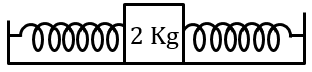
A block of mass 2 kg is attached with two identical springs of spring constant 20 N m$$^{-1}$$ each. The block is placed on a frictionless surface and the ends of the springs are attached to rigid supports (see figure). When the mass is displaced from its equilibrium position, it executes a simple harmonic motion. The time period of oscillation is $$\frac{\pi}{\sqrt{X}}$$ in SI unit. The value of $$X$$ is _____.
Correct Answer: 5
A block of mass $$m = 2 \,\, \text{kg}$$ is connected between two identical horizontal springs, each having a spring constant $$k = 20 \,\, \text{N/m}$$. The outer ends of the springs are anchored to rigid vertical walls.
When the mass is displaced to one side by a distance $$x$$:
Because both restoring forces pull the mass in the same direction to restore equilibrium, the total net force is:
$$F_{\text{net}} = F_1 + F_2 = -kx - kx = -2kx$$
This additive restoring behavior means the two springs are structurally operating in a parallel combination.
For springs connected in parallel, their individual stiffness constants add together directly to create a stiffer system:
$$k_{\text{eq}} = k + k$$
$$k_{\text{eq}} = 20 \,\, \text{N/m} + 20 \,\, \text{N/m} = 40 \,\, \text{N/m}$$
The standard formula for the time period of a spring-mass system executing Simple Harmonic Motion (SHM) is:
$$T = 2\pi \sqrt{\frac{m}{k_{\text{eq}}}}$$
Substitute the mass ($$m = 2 \,\, \text{kg}$$) and the effective spring constant ($$k_{\text{eq}} = 40 \,\, \text{N/m}$$) into the formula:
$$T = 2\pi \sqrt{\frac{2}{40}} = 2\pi \sqrt{\frac{1}{20}}$$
Simplify the expression under the radical sign:
$$T = 2\pi \cdot \frac{1}{\sqrt{4 \times 5}} = 2\pi \cdot \frac{1}{2\sqrt{5}}$$
Canceling out the factor of 2 from both the numerator and denominator yields:
$$T = \frac{\pi}{\sqrt{5}}$$
We are given that the time period of oscillation is expressionally equal to $$\frac{\pi}{\sqrt{X}}$$ in SI units:
$$\frac{\pi}{\sqrt{X}} = \frac{\pi}{\sqrt{5}} \implies X = 5$$
Correct Numerical Answer: 5
Was this solution helpful?
Click on the Email ☝️ to Watch the Video Solution
Create a FREE account and get:
_1.webp)

Educational materials for JEE preparation

Ask our AI anything

AI can make mistakes. Please verify important information.
AI can make mistakes. Please verify important information.


