
Join Our JEE Preparation Group
Prep with like-minded aspirants; Get access to free daily tests and study material.
Sign in
Please select an account to continue using cracku.in
↓ →
Join Our JEE Preparation Group
Prep with like-minded aspirants; Get access to free daily tests and study material.
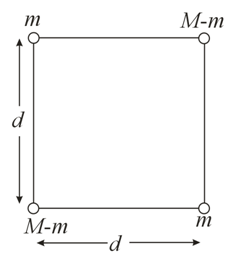
A body of mass $$(2M)$$ splits into four masses $$\{m, M-m, m, M-m\}$$, which are rearranged to form a square as shown in the figure. The ratio of $$\frac{M}{m}$$ for which, the gravitational potential energy of the system becomes maximum is $$x : 1$$. The value of $$x$$ is _________.
Correct Answer: 2
Let the four masses be placed at the corners of a square of side $$d$$ in a cyclic order:
The distance between adjacent corners is $$d$$, and the distance between diagonally opposite corners is $$\sqrt{2}d$$.
The total gravitational potential energy of a system of particles is the sum of the potential energies of all unique pairs:
$$U = -\sum \frac{G m_i m_j}{r_{ij}}$$
Let's calculate the interactions by grouping them by distance:
Combining all pairs, the total potential energy expression is:
$$U = -\frac{G}{d} \left[ 4m(M-m) + \frac{1}{\sqrt{2}}(m^2 + (M-m)^2) \right]$$
Since gravitational potential energy is a negative quantity, maximizing the potential energy means making its absolute magnitude minimum, or directly finding the critical point where $$\frac{dU}{dm} = 0$$.
Let's differentiate the expression inside the bracket with respect to $$m$$ and set it to zero:
$$\frac{d}{dm} \left[ 4(Mm - m^2) + \frac{1}{\sqrt{2}}(m^2 + M^2 - 2Mm + m^2) \right] = 0$$
$$\frac{d}{dm} \left[ 4Mm - 4m^2 + \frac{1}{\sqrt{2}}(2m^2 - 2Mm + M^2) \right] = 0$$
Performing the differentiation step-by-step:
$$\left[ 4M - 8m + \frac{1}{\sqrt{2}}(4m - 2M) \right] = 0$$
$$4M - 8m + \frac{4}{\sqrt{2}}m - \frac{2}{\sqrt{2}}M = 0$$
$$4M - \sqrt{2}M = 8m - 2\sqrt{2}m$$
Factor out $$M$$ on the left side and $$m$$ on the right side:
$$M(4 - \sqrt{2}) = m(8 - 2\sqrt{2})$$
Notice that the right side can be factored further by pulling out a $$2$$:
$$M(4 - \sqrt{2}) = 2m(4 - \sqrt{2})$$
Canceling out the common term $$(4 - \sqrt{2})$$ from both sides gives:
$$M = 2m \implies \frac{M}{m} = 2$$
Given that the ratio $$\frac{M}{m} = x : 1$$, we find that $$x = 2$$.
Final Answer: 2
Create a FREE account and get:
_1.webp)

Educational materials for JEE preparation

Ask our AI anything

AI can make mistakes. Please verify important information.
AI can make mistakes. Please verify important information.


