
Join Our JEE Preparation Group
Prep with like-minded aspirants; Get access to free daily tests and study material.
Sign in
Please select an account to continue using cracku.in
↓ →
Join Our JEE Preparation Group
Prep with like-minded aspirants; Get access to free daily tests and study material.
The coefficient of static friction between two blocks is 0.5 and the table is smooth. The maximum horizontal force that can be applied to move the blocks together is _________ N (take $$g = 10$$ m s$$^{-2}$$)
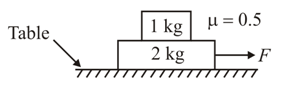
Correct Answer: 15
We need to find the maximum horizontal force $$F$$ that can be applied to the lower block such that both blocks move together without slipping between them.
The static friction between the two blocks keeps the upper $$1\text{ kg}$$ block moving along with the lower $$2\text{ kg}$$ block. The maximum possible static friction force ($$f_{\text{max}}$$) that can act on the upper block is given by:
$$f_{\text{max}} = \mu \cdot N$$
Where:
$$N = m_1 \cdot g = 1\text{ kg} \times 10\text{ m s}^{-2} = 10\text{ N}$$
Substituting the values into the maximum friction formula:
$$f_{\text{max}} = 0.5 \times 10\text{ N} = 5\text{ N}$$
The upper block is accelerated purely due to this frictional force. Therefore, its maximum possible acceleration ($$a_{\text{max}}$$) before it begins to slip is:
$$f_{\text{max}} = m_1 \cdot a_{\text{max}}$$
$$5\text{ N} = 1\text{ kg} \times a_{\text{max}} \implies a_{\text{max}} = 5\text{ m s}^{-2}$$
Since the table is completely smooth, there is no external retarding friction force acting on the bottom surface of the lower block. To prevent slipping, both blocks must move together as a single composite system with a maximum common acceleration of $$a_{\text{max}} = 5\text{ m s}^{-2}$$.
Using Newton's second law for the total mass ($$m_1 + m_2$$):
$$F = (m_1 + m_2) \cdot a_{\text{max}}$$
$$F = (1\text{ kg} + 2\text{ kg}) \times 5\text{ m s}^{-2}$$
$$F = 3\text{ kg} \times 5\text{ m s}^{-2} = 15\text{ N}$$
Final Answer: 15
Was this solution helpful?
Create a FREE account and get:
_1.webp)

Educational materials for JEE preparation

Ask our AI anything

AI can make mistakes. Please verify important information.
AI can make mistakes. Please verify important information.
