
Join Our JEE Preparation Group
Prep with like-minded aspirants; Get access to free daily tests and study material.
Sign in
Please select an account to continue using cracku.in
↓ →
Join Our JEE Preparation Group
Prep with like-minded aspirants; Get access to free daily tests and study material.
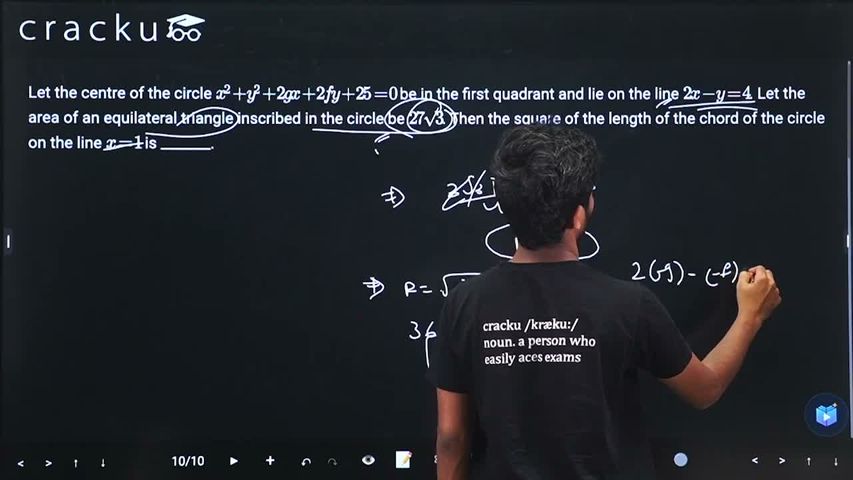
Let the centre of the circle $$x^2 + y^2 + 2gx + 2fy + 25 = 0$$ be in the first quadrant and lie on the line $$2x - y = 4$$. Let the area of an equilateral triangle inscribed in the circle be $$27\sqrt{3}$$. Then the square of the length of the chord of the circle on the line $$x = 1$$ is _______.
Correct Answer: 80
The equation of the circle is $$x^2 + y^2 + 2gx + 2fy + 25 = 0$$.
Center is $$C(-g, -f)$$.
Since the center lies in the first quadrant: $$-g > 0 \implies g < 0$$ and $$-f > 0 \implies f < 0$$.
The center lies on $$2x - y = 4 \implies 2(-g) - (-f) = 4 \implies f = 2g + 4$$.
Radius $$R = \sqrt{g^2 + f^2 - 25}$$.
$$\text{Area} = \frac{3\sqrt{3}}{4}R^2$$
$$\frac{3\sqrt{3}}{4}R^2 = 27\sqrt{3} \implies R^2 = 36 \implies R = 6$$
$$g^2 + f^2 - 25 = 36 \implies g^2 + f^2 = 61$$
$$g^2 + (2g + 4)^2 = 61$$
$$5g^2 + 16g - 45 = 0$$
$$(5g - 9)(g + 5) = 0 \implies g = -5 \quad (\text{since } g < 0)$$
$$f = 2(-5) + 4 = -6$$
Thus, the center of the circle is $$C(-g, -f) = (5, 6)$$
The perpendicular distance ($$d$$) from the center $$(5, 6)$$ to the vertical line $$x = 1$$ is: $$d = |5 - 1| = 4$$
$$L = 2\sqrt{R^2 - d^2}$$
$$L^2 = 4(R^2 - d^2) = 4(36 - 16) = 4(20) = 80$$
Was this solution helpful?
Click on the Email ☝️ to Watch the Video Solution
Create a FREE account and get:
_1.webp)

Educational materials for JEE preparation

Ask our AI anything

AI can make mistakes. Please verify important information.
AI can make mistakes. Please verify important information.


