
Join Our JEE Preparation Group
Prep with like-minded aspirants; Get access to free daily tests and study material.
Sign in
Please select an account to continue using cracku.in
↓ →
Join Our JEE Preparation Group
Prep with like-minded aspirants; Get access to free daily tests and study material.
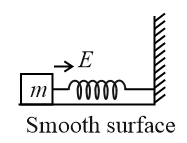
A block of mass 'm' (as shown in figure) moving with kinetic energy E compresses a spring through a distance 25 cm when, its speed is halved. The value of spring constant of used spring will be $$nE$$ N m$$^{-1}$$ for $$n$$ = _____.
Correct Answer: 24
We need to find the value of the integer $$n$$ given that a block of mass $$m$$ with initial kinetic energy $$E$$ compresses a spring by a distance of 25 cm when its speed is halved.
The initial kinetic energy of the block before hitting the spring is given by: $$E = \frac{1}{2} m v^2$$, where $$v$$ is the initial speed of the block.
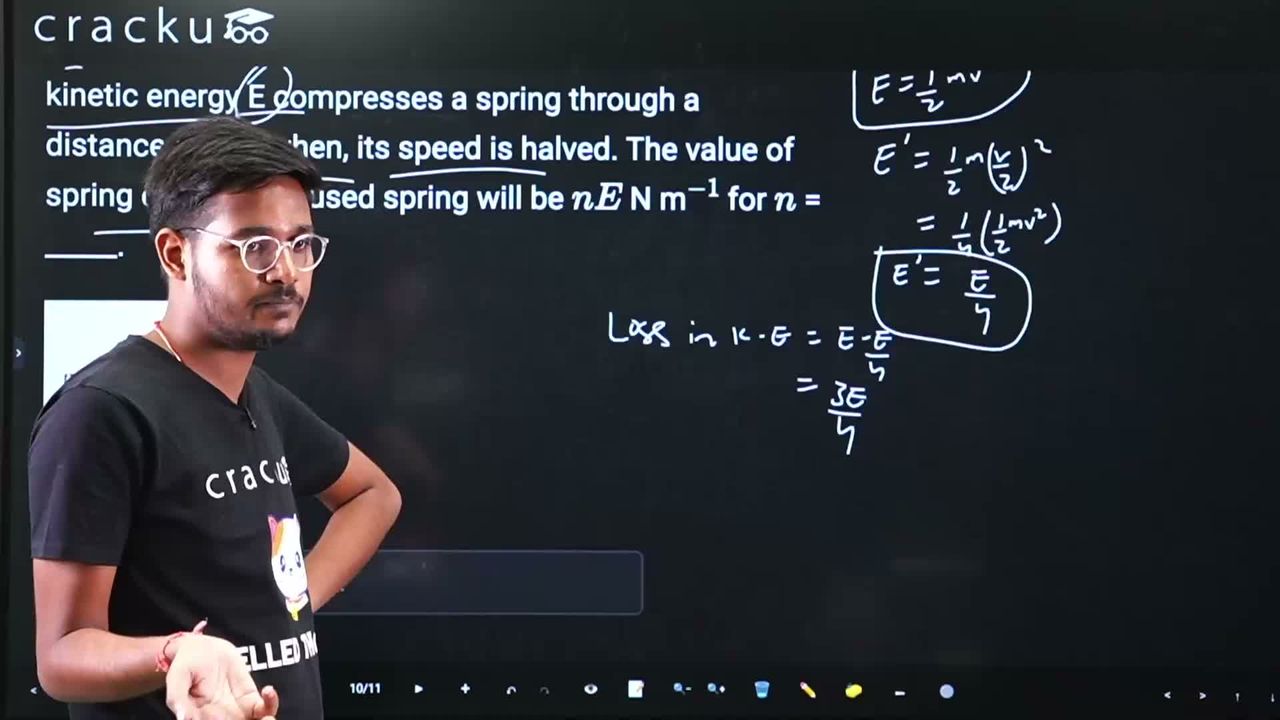
When the block compresses the spring and its speed is halved, its new speed becomes $$\frac{v}{2}$$. The final kinetic energy of the block at this instant is: $$E_{final} = \frac{1}{2} m \left(\frac{v}{2}\right)^2 = \frac{1}{4} \left(\frac{1}{2} m v^2\right) = \frac{E}{4}$$.
According to the law of conservation of mechanical energy, the loss in kinetic energy of the block is equal to the gain in elastic potential energy stored in the spring: $$\Delta KE = U_{spring}$$.
The energy stored in the spring when compressed by a distance $$x$$ is given by $$\frac{1}{2} k x^2$$, where $$k$$ is the spring constant. Substituting the energy values, we get: $$E - \frac{E}{4} = \frac{1}{2} k x^2$$, which simplifies to: $$\frac{3}{4} E = \frac{1}{2} k x^2$$.
Solving the expression for the spring constant $$k$$ yields: $$k = \frac{3 E}{2 x^2}$$.
We are given that the compression distance is $$x = 25\text{ cm} = 0.25\text{ m} = \frac{1}{4}\text{ m}$$. Substituting this value into the formula gives: $$k = \frac{3 E}{2 \left(\frac{1}{4}\right)^2} = \frac{3 E}{2 \times \frac{1}{16}} = \frac{3 E}{\frac{1}{8}} = 24 E$$.
Comparing this with the given expression for the spring constant $$k = n E$$, we find that $$n = 24$$.
Therefore, the value of $$n$$ is 24.
Click on the Email ☝️ to Watch the Video Solution
Create a FREE account and get:
_1.webp)

Educational materials for JEE preparation

Ask our AI anything

AI can make mistakes. Please verify important information.
AI can make mistakes. Please verify important information.


