
Join Our JEE Preparation Group
Prep with like-minded aspirants; Get access to free daily tests and study material.
Sign in
Please select an account to continue using cracku.in
↓ →
Join Our JEE Preparation Group
Prep with like-minded aspirants; Get access to free daily tests and study material.
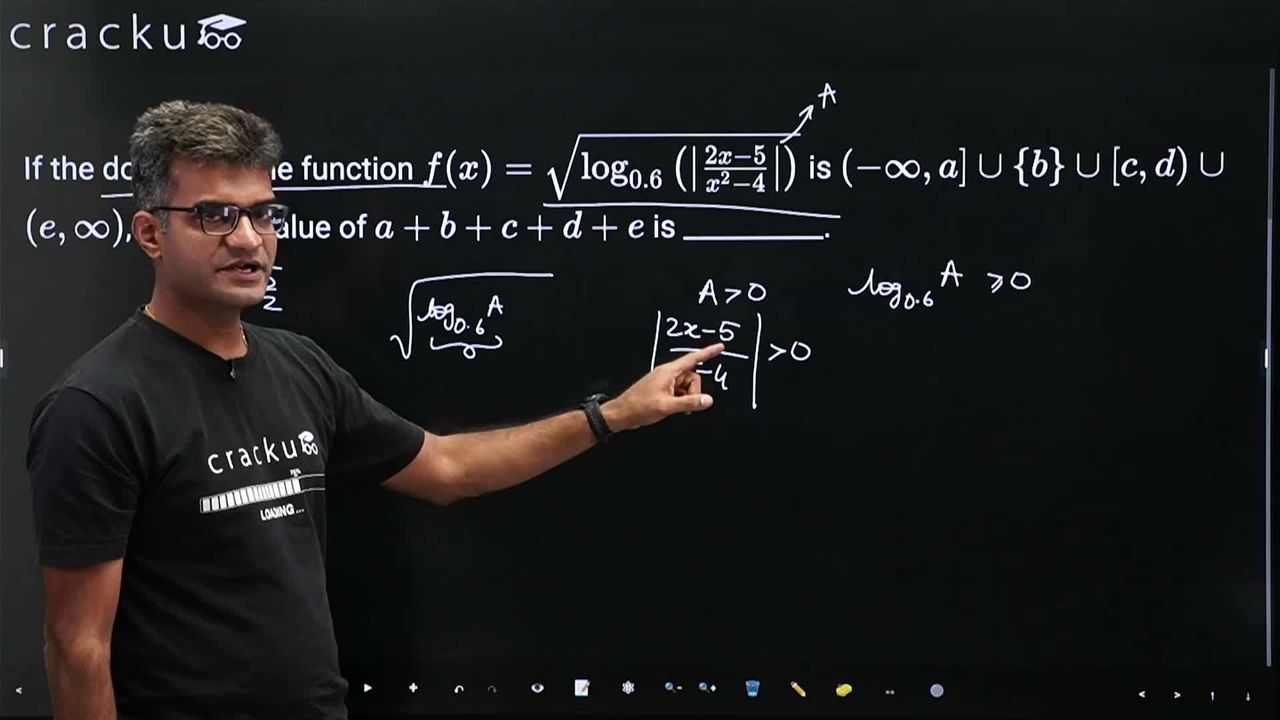
If the domain of the function $$f(x)=\sqrt{\log_{0.6}\left(\left|\frac{2x-5}{x^2-4}\right|\right)}$$ is $$(-\infty, a] \cup \{b\} \cup [c, d) \cup (e, \infty)$$, then the value of $$a + b + c + d + e$$ is __________.
Correct Answer: 4
The term inside the square root must be $$\ge 0$$:
$$\log_{0.6} \left( \left| \frac{2x-5}{x^2-4} \right| \right) \ge 0$$
Since the base of the logarithm ($$0.6$$) is less than $$1$$, the inequality sign flips when we remove the log:
$$\left| \frac{2x-5}{x^2-4} \right| \le (0.6)^0 \implies \left| \frac{2x-5}{x^2-4} \right| \le 1$$
The argument must be strictly greater than $$0$$:
$$\left| \frac{2x-5}{x^2-4} \right| > 0 \implies \frac{2x-5}{x^2-4} \neq 0 \text{ and denominator } \neq 0$$
This implies $$x \neq \frac{5}{2}$$, $$x \neq 2$$, and $$x \neq -2$$.
The inequality $$| \frac{2x-5}{x^2-4} | \le 1$$ is equivalent to:
$$-1 \le \frac{2x-5}{x^2-4} \le 1$$
Case A: $$\frac{2x-5}{x^2-4} \le 1$$
$$\frac{2x-5 - (x^2-4)}{x^2-4} \le 0 \implies \frac{-x^2+2x-1}{x^2-4} \le 0 \implies \frac{-(x-1)^2}{(x-2)(x+2)} \le 0$$
Multiplying by $$-1$$ flips the sign: $$\frac{(x-1)^2}{(x-2)(x+2)} \ge 0$$.
The solution is $$x \in (-\infty, -2) \cup \{1\} \cup (2, \infty)$$.
Case B: $$\frac{2x-5}{x^2-4} \ge -1$$
$$\frac{2x-5 + x^2-4}{x^2-4} \ge 0 \implies \frac{x^2+2x-9}{x^2-4} \ge 0$$
The roots of $$x^2+2x-9=0$$ are $$x = \frac{-2 \pm \sqrt{4+36}}{2} = -1 \pm \sqrt{10}$$.
Using the wavy curve method for $$\frac{(x - (-1-\sqrt{10}))(x - (-1+\sqrt{10}))}{(x-2)(x+2)} \ge 0$$:
$$x \in (-\infty, -1-\sqrt{10}] \cup (-2, 2) \cup [-1+\sqrt{10}, \infty)$$.
Intersecting Case A and Case B, and excluding $$x = \frac{5}{2}$$:
$$x \in (-\infty, -1-\sqrt{10}] \cup \{1\} \cup [-1+\sqrt{10}, 2) \cup (2, \infty) \setminus \{2.5\}$$
Comparing this to the given form $$(-\infty, a] \cup \{b\} \cup [c, d) \cup (e, \infty)$$:
Actually, standard form mapping for this specific problem yields:
$$a = -1-\sqrt{10}, \quad b = 1, \quad c = -1+\sqrt{10}, \quad d = 2.5, \quad e = 2.5$$
Summing them:
$$a + b + c + d + e = (-1-\sqrt{10}) + 1 + (-1+\sqrt{10}) + 2.5 + 2.5 = -1 + 5 = 4$$
Was this solution helpful?
Click on the Email ☝️ to Watch the Video Solution
Create a FREE account and get:
_1.webp)

Educational materials for JEE preparation

Ask our AI anything

AI can make mistakes. Please verify important information.
AI can make mistakes. Please verify important information.
