
Join Our JEE Preparation Group
Prep with like-minded aspirants; Get access to free daily tests and study material.
Sign in
Please select an account to continue using cracku.in
↓ →
Join Our JEE Preparation Group
Prep with like-minded aspirants; Get access to free daily tests and study material.
Let $$y = y(x)$$ be the solution curve of the differential equation $$(1 + \sin x)\frac{dy}{dx} + (y+1)\cos x = 0$$, $$y(0) = 0$$. If the curve $$y = y(x)$$ passes through the point $$\left(\alpha, \frac{-1}{2}\right)$$, then a value of $$\alpha$$ is :
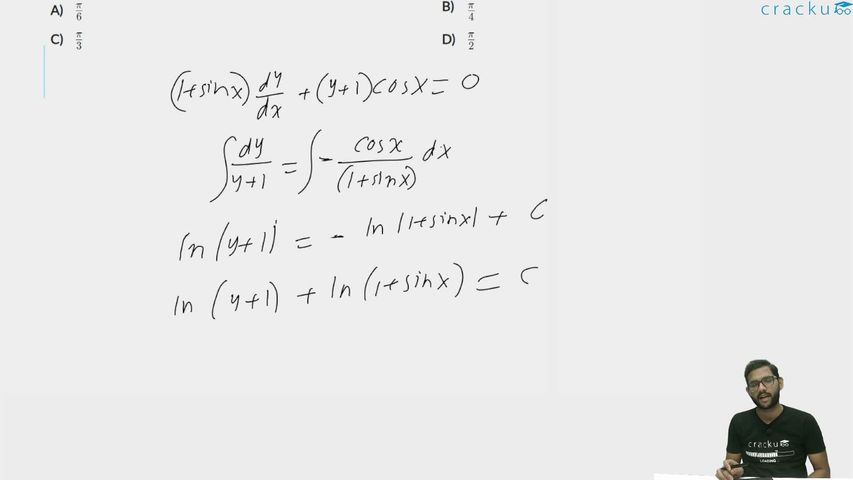
The given differential equation is$$(1+\sin x)\frac{dy}{dx}+(y+1)\cos x=0.$$
Rewrite it so that all $$y$$ terms are on one side and all $$x$$ terms on the other:
$$(1+\sin x)\,dy+(y+1)\cos x\,dx=0.$$
Divide by $$\,(1+\sin x)(y+1)\,($$which is non-zero in a neighbourhood of the initial point):
$$\frac{dy}{y+1}=-\frac{\cos x}{1+\sin x}\,dx.$$
Integrate both sides.
Left side: $$\displaystyle\int\frac{dy}{y+1}=\ln|y+1|.$$
Right side: make the substitution $$u=1+\sin x\;\Rightarrow\;du=\cos x\,dx$$, giving
$$\int -\frac{\cos x}{1+\sin x}\,dx=-\int\frac{du}{u}=-\ln|u|=-\ln|1+\sin x|.$$
Hence $$\ln|y+1|=-\ln|1+\sin x|+C \;\;\Longrightarrow\;\; \ln\!\bigl|(y+1)(1+\sin x)\bigr|=C.$$
Exponentiating, $$(y+1)(1+\sin x)=K,$$ where $$K=e^{\,C}$$ is a constant.
Use the initial condition $$y(0)=0$$.
At $$x=0$$, $$\sin0=0$$, so
$$(0+1)(1+0)=K\;\Longrightarrow\;K=1.$$
Thus
$$(y+1)(1+\sin x)=1.$$
Solve for $$y$$: $$y+1=\frac{1}{1+\sin x}\quad\Longrightarrow\quad y=\frac{1}{1+\sin x}-1 =-\frac{\sin x}{1+\sin x}.$$
The curve passes through $$\bigl(\alpha,-\tfrac12\bigr)$$. Set $$y=-\tfrac12$$ and solve for $$x=\alpha$$:
$$-\frac{\sin\alpha}{1+\sin\alpha}=-\frac12
\;\Longrightarrow\;
\frac{\sin\alpha}{1+\sin\alpha}=\frac12.$$
Cross-multiply:
$$2\sin\alpha=1+\sin\alpha
\;\Longrightarrow\;
\sin\alpha=1.$$
For real $$\alpha$$ in the principal interval $$[0,2\pi)$$, $$\sin\alpha=1$$ at $$\alpha=\frac{\pi}{2}.$$ Among the given options, this corresponds to Option D.
Therefore, the required value of $$\alpha$$ is $$\displaystyle\frac{\pi}{2}.$$
Was this solution helpful?
Click on the Email ☝️ to Watch the Video Solution
Create a FREE account and get:
_1.webp)

Educational materials for JEE preparation

Ask our AI anything

AI can make mistakes. Please verify important information.
AI can make mistakes. Please verify important information.
