
Join Our JEE Preparation Group
Prep with like-minded aspirants; Get access to free daily tests and study material.
Sign in
Please select an account to continue using cracku.in
↓ →
Join Our JEE Preparation Group
Prep with like-minded aspirants; Get access to free daily tests and study material.
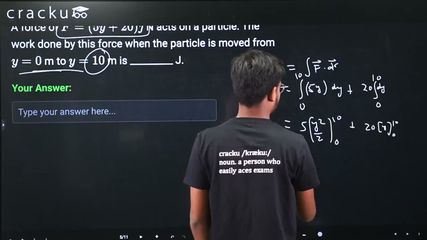
A force of $$F = (5y + 20)\hat{j}$$ N acts on a particle. The work done by this force when the particle is moved from $$y = 0$$ m to $$y = 10$$ m is _________ J.
Correct Answer: 450
We start with the definition of mechanical work done by a variable force. In vector form, the small (differential) work done $$dW$$ when the particle is displaced by an element $$d\vec r$$ is given by the dot-product formula
$$dW \;=\; \vec F \,\cdot\, d\vec r.$$
To obtain the total work $$W$$ along a path, we integrate this expression:
$$W \;=\; \displaystyle\int \vec F \,\cdot\, d\vec r.$$
In the present situation the force is purely in the $$\hat{j}$$ (i.e., $$y$$) direction and has the magnitude
$$\vec F \;=\; (5y + 20)\,\hat{j}\;\text{N}.$$
The particle is moved only along the $$y$$-axis, from the initial point $$y = 0\;\text{m}$$ to the final point $$y = 10\;\text{m}$$. Hence the displacement element is purely $$d\vec r = dy\,\hat{j}$$. The dot product of the force with this displacement is therefore simply the product of their magnitudes because both vectors are parallel:
$$\vec F \,\cdot\, d\vec r = (5y + 20)\,\hat{j}\;\cdot\; dy\,\hat{j} = (5y + 20)\,dy.$$
Now substitute this result into the integral for work:
$$W = \displaystyle\int_{y=0}^{y=10} (5y + 20)\,dy.$$
We split the integral into two separate, easier integrals:
$$W = \int_{0}^{10} 5y\,dy \;+\; \int_{0}^{10} 20\,dy.$$
Let us evaluate each part one by one.
For the first integral, we use the power rule $$\int y\,dy = \dfrac{y^{2}}{2}\,.$$ Hence
$$\int_{0}^{10} 5y\,dy \;=\; 5 \left[\dfrac{y^{2}}{2}\right]_{0}^{10} = 5 \left(\dfrac{10^{2}}{2} - \dfrac{0^{2}}{2}\right) = 5 \left(\dfrac{100}{2}\right) = 5 \times 50 = 250 \;\text{J}.$$
For the second integral, $$\int 20\,dy = 20y$$. So
$$\int_{0}^{10} 20\,dy \;=\; 20\,[y]_{0}^{10} = 20\,(10 - 0) = 20 \times 10 = 200 \;\text{J}.$$
Finally, we add the two contributions to obtain the total work:
$$W = 250 \;\text{J} + 200 \;\text{J} = 450 \;\text{J}.$$
So, the answer is $$450$$.
Was this solution helpful?
Click on the Email ☝️ to Watch the Video Solution
Create a FREE account and get:
_1.webp)

Educational materials for JEE preparation

Ask our AI anything

AI can make mistakes. Please verify important information.
AI can make mistakes. Please verify important information.
