
Join Our JEE Preparation Group
Prep with like-minded aspirants; Get access to free daily tests and study material.
Sign in
Please select an account to continue using cracku.in
↓ →
Join Our JEE Preparation Group
Prep with like-minded aspirants; Get access to free daily tests and study material.
A solid disc of radius 20 cm and mass 10 kg is rotating with an angular velocity of 600 rpm, about an axis normal to its circular plane and passing through its centre of mass. The retarding torque required to bring the disc at rest in 10 s is _________ $$\pi \times 10^{-1}$$ N m
Correct Answer: 4
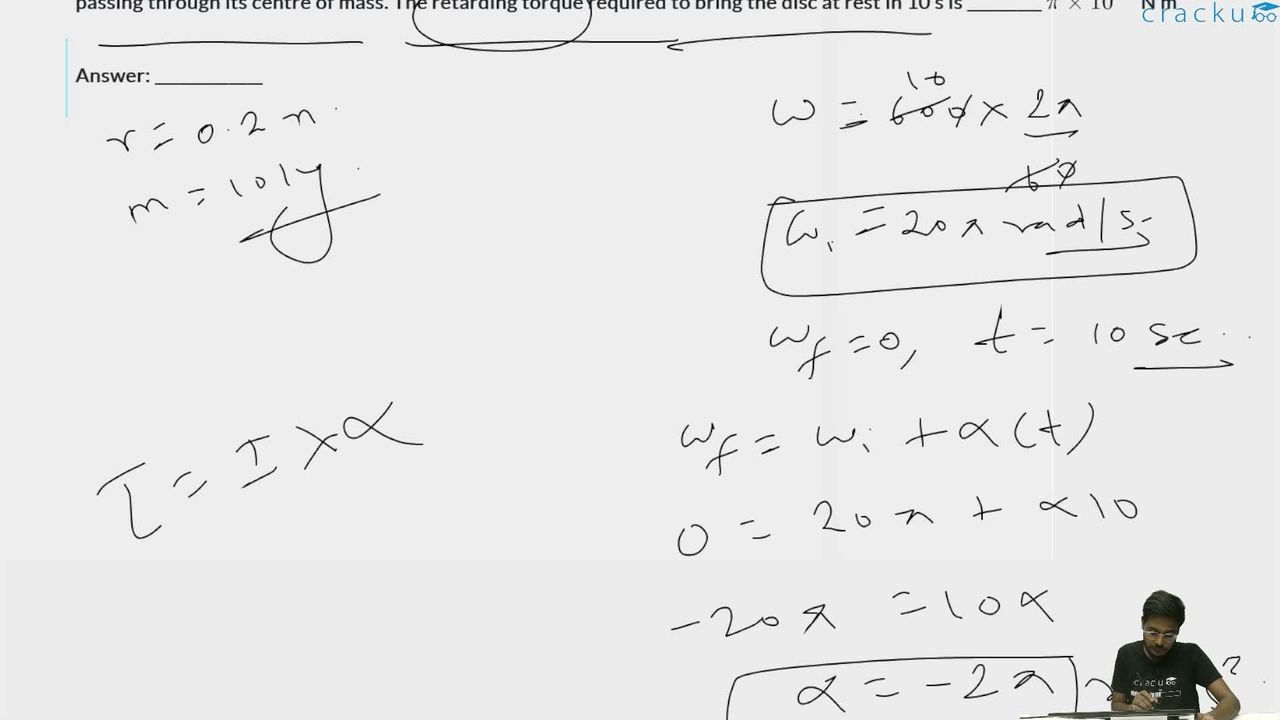
We have a solid disc of mass $$M = 10\;\text{kg}$$ and radius $$R = 20\;\text{cm} = 0.20\;\text{m}$$ rotating with an initial angular velocity of $$600\;\text{rpm}$$ about its central axis. First, we convert this angular speed to SI units.
The relation between revolutions per minute and radians per second is
$$\omega = \text{(rev/min)} \times \frac{2\pi\;\text{rad}}{1\;\text{rev}} \times \frac{1\;\text{min}}{60\;\text{s}}.$$
Substituting the given value,
$$\omega_i = 600 \times \frac{2\pi}{60} = 600 \times \frac{2\pi}{60} = 10 \times 2\pi = 20\pi\; \text{rad s}^{-1}.$$
The disc has to be brought to rest in $$t = 10\;\text{s}$$, so the final angular velocity is $$\omega_f = 0$$. For constant angular deceleration $$\alpha$$ we use
$$\omega_f = \omega_i + \alpha t.$$
Rearranging,
$$\alpha = \frac{\omega_f - \omega_i}{t} = \frac{0 - 20\pi}{10} = -2\pi\;\text{rad s}^{-2}.$$
The minus sign merely shows that the acceleration is retarding; its magnitude is $$|\alpha| = 2\pi\;\text{rad s}^{-2}.$$
Now we need the moment of inertia of a solid disk about its central axis. The formula is stated as
$$I = \frac{1}{2} M R^{2}.$$
Substituting $$M = 10\;\text{kg}$$ and $$R = 0.20\;\text{m},$$
$$I = \frac{1}{2}(10)(0.20)^2 = \frac{1}{2}(10)(0.04) = 0.2\;\text{kg m}^{2}.$$
The magnitude of the required retarding torque $$\tau$$ is connected to angular acceleration by
$$\tau = I\,|\alpha|.$$
Substituting $$I = 0.2\;\text{kg m}^{2}$$ and $$|\alpha| = 2\pi\;\text{rad s}^{-2},$$
$$\tau = 0.2 \times 2\pi = 0.4\pi\;\text{N m}.$$
We express $$0.4\pi$$ in the form $$k \times \pi \times 10^{-1}$$. Noting that $$0.4 = 4 \times 10^{-1},$$ we write
$$\tau = 4\,\pi \times 10^{-1}\;\text{N m}.$$
Thus the numeral to be filled in the blank is $$4$$.
Hence, the correct answer is Option 4.
Was this solution helpful?
Click on the Email ☝️ to Watch the Video Solution
Create a FREE account and get:
_1.webp)

Educational materials for JEE preparation

Ask our AI anything

AI can make mistakes. Please verify important information.
AI can make mistakes. Please verify important information.
