
Join Our JEE Preparation Group
Prep with like-minded aspirants; Get access to free daily tests and study material.
Sign in
Please select an account to continue using cracku.in
↓ →
Join Our JEE Preparation Group
Prep with like-minded aspirants; Get access to free daily tests and study material.
When radiation of wavelength $$\lambda$$ is incident on a metallic surface, the stopping potential of ejected photoelectrons is 4.8 V. If the same surface is illuminated by radiation of double the previous wavelength, then the stopping potential becomes 1.6 V. The threshold wavelength of the metal is:
We recall the Einstein photoelectric equation. It states that for incident light of wavelength $$\lambda$$ on a metal of threshold wavelength $$\lambda_0$$, the stopping potential $$V_s$$ is related by
$$eV_s \;=\; h\nu \;-\; \phi,$$
where $$\nu=\dfrac{c}{\lambda}$$ is the frequency, $$\phi = h\nu_0 = \dfrac{hc}{\lambda_0}$$ is the work-function, and $$e$$ is the electronic charge. Substituting $$\nu=\dfrac{c}{\lambda}$$ and simplifying gives the working form
$$eV_s \;=\; hc\left(\dfrac{1}{\lambda}-\dfrac{1}{\lambda_0}\right).$$
For convenience we define the constant $$k=\dfrac{hc}{e}$$ so that the equation becomes
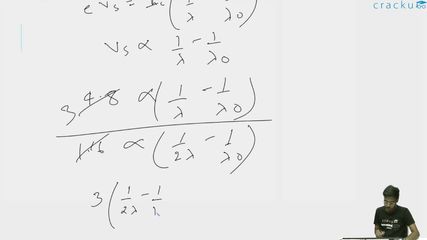
$$V_s \;=\; k\left(\dfrac{1}{\lambda}-\dfrac{1}{\lambda_0}\right). \quad -(1)$$
We now apply this relation to the two experimental situations described in the problem.
First illumination: wavelength $$\lambda$$, stopping potential $$V_1 = 4.8\text{ V}$$. Substituting in (1) we get
$$4.8 = k\left(\dfrac{1}{\lambda}-\dfrac{1}{\lambda_0}\right). \quad -(2)$$
Second illumination: wavelength $$2\lambda$$, stopping potential $$V_2 = 1.6\text{ V}$$. Using (1) again, we obtain
$$1.6 = k\left(\dfrac{1}{2\lambda}-\dfrac{1}{\lambda_0}\right). \quad -(3)$$
Our goal is to eliminate $$k$$ and find $$\lambda_0$$ in terms of $$\lambda$$. We start by expressing $$\dfrac{1}{\lambda_0}$$ from equation (2):
$$\dfrac{1}{\lambda_0} = \dfrac{1}{\lambda} - \dfrac{4.8}{k}. \quad -(4)$$
Now we substitute this expression for $$\dfrac{1}{\lambda_0}$$ into equation (3):
$$1.6 = k\left[\dfrac{1}{2\lambda} - \left(\dfrac{1}{\lambda} - \dfrac{4.8}{k}\right)\right].$$
Expanding the bracket gives
$$1.6 = k\left[\dfrac{1}{2\lambda} - \dfrac{1}{\lambda} + \dfrac{4.8}{k}\right].$$
The first two terms inside the bracket combine as
$$\dfrac{1}{2\lambda} - \dfrac{1}{\lambda} = -\dfrac{1}{2\lambda},$$
so we obtain
$$1.6 = k\left[-\dfrac{1}{2\lambda}\right] + 4.8.$$
Rearranging to isolate the term in $$\lambda$$, we move $$4.8$$ to the left side:
$$1.6 - 4.8 = -\,k\,\dfrac{1}{2\lambda}.$$
This simplifies to
$$( -3.2 ) = -\,k\,\dfrac{1}{2\lambda},$$
and therefore
$$\dfrac{1}{2\lambda} = \dfrac{3.2}{k}.$$
Multiplying both sides by 2 gives the reciprocal of $$\lambda$$:
$$\dfrac{1}{\lambda} = \dfrac{6.4}{k}. \quad -(5)$$
With $$\dfrac{1}{\lambda}$$ known, we return to equation (4) to find $$\dfrac{1}{\lambda_0}$$:
$$\dfrac{1}{\lambda_0} = \dfrac{6.4}{k} - \dfrac{4.8}{k} = \dfrac{1.6}{k}.$$
Taking reciprocals to get $$\lambda_0$$ itself, we find
$$\lambda_0 = \dfrac{k}{1.6}.$$
Equation (5) similarly gives
$$\lambda = \dfrac{k}{6.4}.$$
Dividing $$\lambda_0$$ by $$\lambda$$ produces
$$\dfrac{\lambda_0}{\lambda} = \dfrac{k/1.6}{k/6.4} = \dfrac{6.4}{1.6} = 4.$$
Thus
$$\lambda_0 = 4\lambda.$$
The threshold wavelength of the metal is therefore four times the given wavelength. Among the options provided, this corresponds to option B: $$4\lambda$$.
Hence, the correct answer is Option B.
Was this solution helpful?
Click on the Email ☝️ to Watch the Video Solution
Create a FREE account and get:
_1.webp)

Educational materials for JEE preparation

Ask our AI anything

AI can make mistakes. Please verify important information.
AI can make mistakes. Please verify important information.
