
Join Our JEE Preparation Group
Prep with like-minded aspirants; Get access to free daily tests and study material.
Sign in
Please select an account to continue using cracku.in
↓ →
Join Our JEE Preparation Group
Prep with like-minded aspirants; Get access to free daily tests and study material.
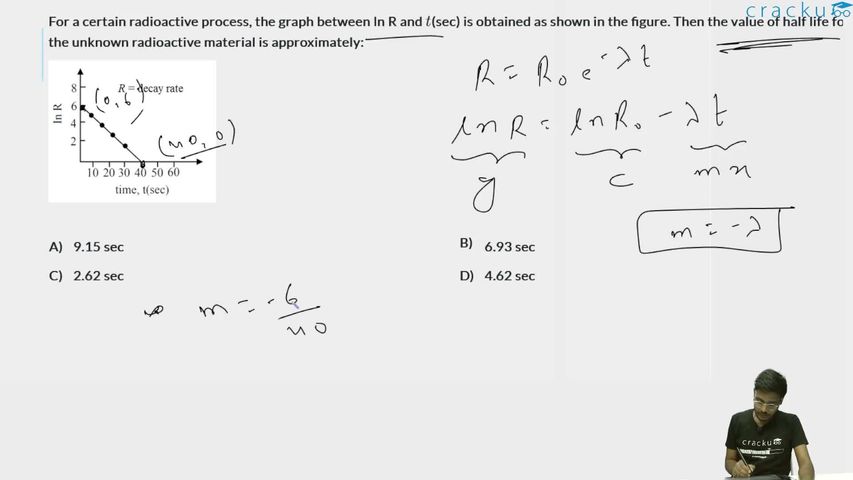
For a certain radioactive process, the graph between ln R and $$t$$(sec) is obtained as shown in the figure. Then the value of half life for the unknown radioactive material is approximately:
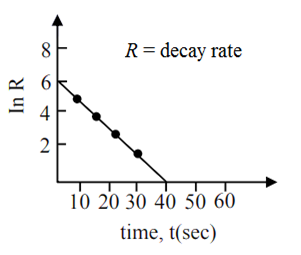
We need to determine the approximate half-life ($$t_{1/2}$$) of an unknown radioactive material using the given linear graph between the natural logarithm of the decay rate ($$\ln R$$) and time ($$t$$).
The decay rate (or activity) $$R$$ of a radioactive substance at any given time $$t$$ follows the exponential decay law:
$$R = R_0 e^{-\lambda t}$$
Where $$R_0$$ is the initial decay rate at $$t = 0$$, and $$\lambda$$ is the radioactive decay constant.
Taking the natural logarithm ($\ln$) on both sides of the equation:
$$\ln R = \ln(R_0 e^{-\lambda t})$$
$$\ln R = \ln R_0 + \ln(e^{-\lambda t})$$
$$\ln R = -\lambda t + \ln R_0$$
Comparing this with the standard equation of a straight line ($$y = mx + c$$), where $$y = \ln R$$ and $$x = t$$:
From the provided graph, we can easily identify two key points where the straight line intercepts the axes:
Now, we compute the slope ($$m$$) of this straight line:
$$m = \frac{y_2 - y_1}{x_2 - x_1} = \frac{0 - 6}{40 - 0} = -\frac{6}{40} = -0.15\text{ s}^{-1}$$
Since the slope of our line is equal to $$-\lambda$$:
$$-\lambda = -0.15 \implies \lambda = 0.15\text{ s}^{-1}$$
The standard formula linking the half-life period to the decay constant is:
$$t_{1/2} = \frac{\ln 2}{\lambda} \approx \frac{0.693}{\lambda}$$
Substituting the value of $$\lambda = 0.15\text{ s}^{-1}$$ into this relation:
$$t_{1/2} = \frac{0.693}{0.15} = \frac{69.3}{15} \approx 4.62\text{ sec}$$
Final Answer: 4.62 sec (Option D)
Was this solution helpful?
Click on the Email ☝️ to Watch the Video Solution
Create a FREE account and get:
_1.webp)

Educational materials for JEE preparation

Ask our AI anything

AI can make mistakes. Please verify important information.
AI can make mistakes. Please verify important information.
