
Join Our JEE Preparation Group
Prep with like-minded aspirants; Get access to free daily tests and study material.
Sign in
Please select an account to continue using cracku.in
↓ →
Join Our JEE Preparation Group
Prep with like-minded aspirants; Get access to free daily tests and study material.
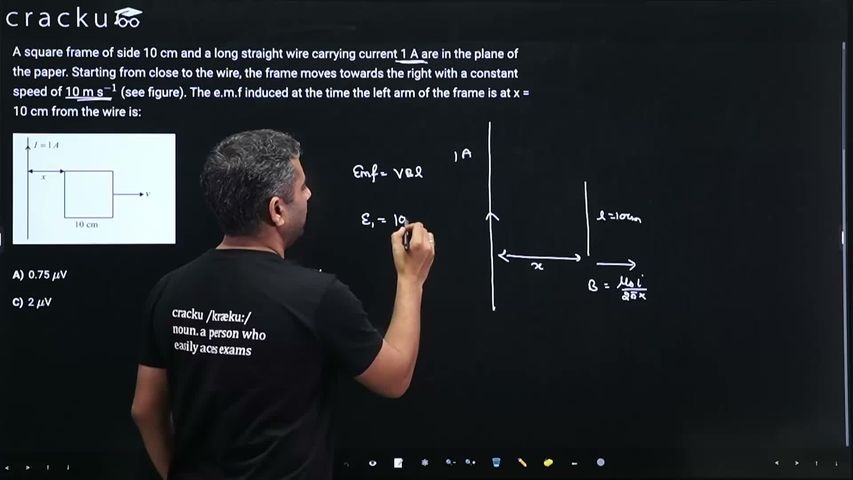
A square frame of side 10 cm and a long straight wire carrying current 1 A are in the plane of the paper. Starting from close to the wire, the frame moves towards the right with a constant speed of 10 m s$$^{-1}$$ (see figure). The e.m.f induced at the time the left arm of the frame is at x = 10 cm from the wire is:
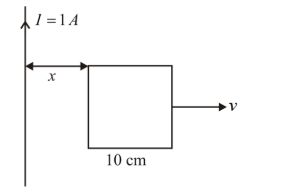
The magnetic field at a distance $$r$$ from a long straight wire carrying current $$I$$ is $$B = \frac{\mu_0 I}{2\pi r}$$
The e.m.f. induced in a conductor of length $$l$$ moving with velocity $$v$$ perpendicular to a magnetic field $$B$$ is given by $$e = Blv$$.
$$e_1 = B_1 lv = \left( \frac{\mu_0 I}{2\pi x} \right) av$$ (left arm)
$$e_2 = B_2 lv = \left( \frac{\mu_0 I}{2\pi (x+a)} \right) av$$ (right arm)
$$\varepsilon = e_1 - e_2 = \frac{\mu_0 I av}{2\pi} \left[ \frac{1}{x} - \frac{1}{x+a} \right]$$
$$\varepsilon = (2 \times 10^{-7}) \times (1) \times (0.1) \times (10) \times \left[ \frac{1}{0.1} - \frac{1}{0.1+0.1} \right]$$
$$\varepsilon = 10^{-6}\text{ V} = 1\text{ }\mu\text{V}$$
Was this solution helpful?
Click on the Email ☝️ to Watch the Video Solution
Create a FREE account and get:
_1.webp)

Educational materials for JEE preparation

Ask our AI anything

AI can make mistakes. Please verify important information.
AI can make mistakes. Please verify important information.
