
Join Our JEE Preparation Group
Prep with like-minded aspirants; Get access to free daily tests and study material.
Sign in
Please select an account to continue using cracku.in
↓ →
Join Our JEE Preparation Group
Prep with like-minded aspirants; Get access to free daily tests and study material.
The angle between vector $$\left(\vec{A}\right)$$ and $$\left(\vec{A} - \vec{B}\right)$$ is:
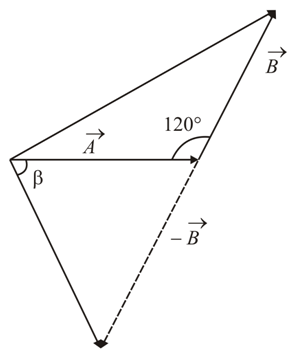
We need to find the angle between the vector $$\vec{A}$$ and the resultant vector $$\vec{A} - \vec{B}$$. From the options, we can infer that the angle between vector $$\vec{A}$$ and vector $$\vec{B}$$ is given as $$\theta = 60^\circ$$.
The vector subtraction $$\vec{R} = \vec{A} - \vec{B}$$ can be treated as the vector addition of $$\vec{A}$$ and $$(-\vec{B})$$:
$$\vec{R} = \vec{A} + (-\vec{B})$$
If the angle between $$\vec{A}$$ and $$\vec{B}$$ is $$\theta$$, then the angle between $$\vec{A}$$ and $$-\vec{B}$$ is $$(180^\circ - \theta)$$.
Let $$\alpha$$ be the angle that the resultant vector $$\vec{R} = \vec{A} - \vec{B}$$ makes with the vector $$\vec{A}$$. Using the standard vector direction formula:
$$\tan \alpha = \frac{B \sin(180^\circ - \theta)}{A + B \cos(180^\circ - \theta)}$$
Using the trigonometric identities $$\sin(180^\circ - \theta) = \sin \theta$$ and $$\cos(180^\circ - \theta) = -\cos \theta$$, the expression simplifies to:
$$\tan \alpha = \frac{B \sin \theta}{A - B \cos \theta}$$
Let's substitute the values for $$\sin 60^\circ = \frac{\sqrt{3}}{2}$$ and $$\cos 60^\circ = \frac{1}{2}$$ into the expression:
$$\tan \alpha = \frac{B \left(\frac{\sqrt{3}}{2}\right)}{A - B \left(\frac{1}{2}\right)}$$
To eliminate the fractions in the numerator and denominator, multiply both top and bottom by $$2$$:
$$\tan \alpha = \frac{\sqrt{3}B}{2A - B}$$
Taking the inverse tangent of both sides isolates the angle $$\alpha$$:
$$\alpha = \tan^{-1}\left(\frac{\sqrt{3}B}{2A - B}\right)$$
Final Answer: Option B $$\left[ \tan^{-1}\left(\frac{\sqrt{3}B}{2A - B}\right) \right]$$
Was this solution helpful?
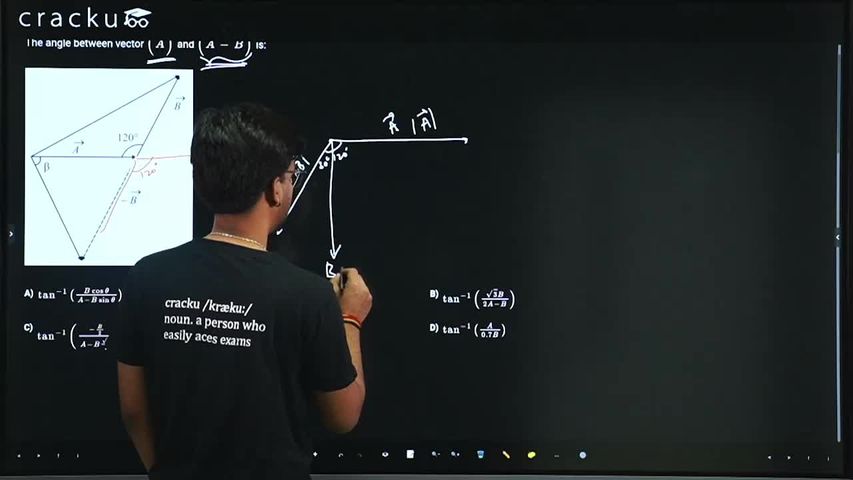
Click on the Email ☝️ to Watch the Video Solution
Create a FREE account and get:
_1.webp)

Educational materials for JEE preparation

Ask our AI anything

AI can make mistakes. Please verify important information.
AI can make mistakes. Please verify important information.
