Join Our JEE Preparation Group
Prep with like-minded aspirants; Get access to free daily tests and study material.
Sign in
Please select an account to continue using cracku.in
↓ →
Join Our JEE Preparation Group
Prep with like-minded aspirants; Get access to free daily tests and study material.
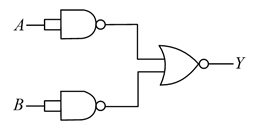
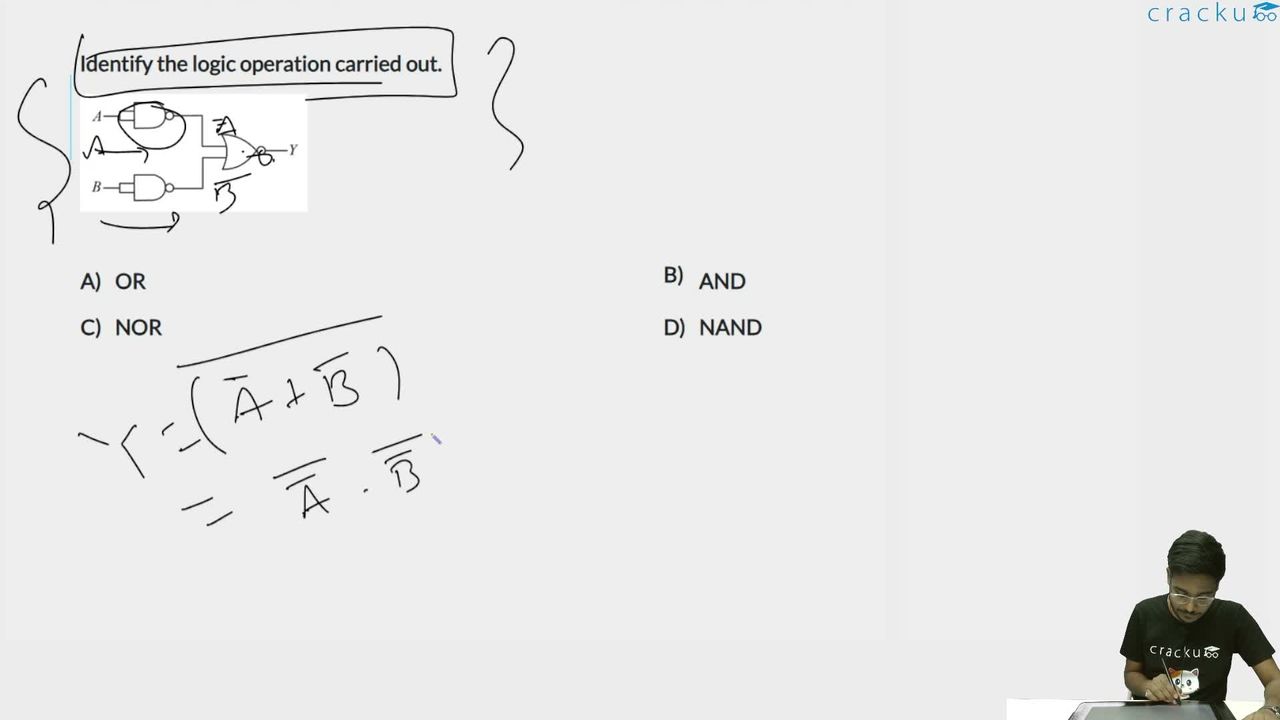
We need to identify the overall logic operation carried out by the given combinational digital circuit.
Let's look at the first layer of the circuit connected to inputs $$A$$ and $$B$$:
The output of this gate is: $$\bar{A}$$
The output of this gate is: $$\bar{B}$$
The outputs from the first stage ($$\bar{A}$$ and $$\bar{B}$$) serve as the inputs to the final gate, which is a NOR gate.
A standard NOR gate produces an output that is the inverted sum of its inputs. Therefore, the final output $$Y$$ is given by:
$$Y = \overline{\bar{A} + \bar{B}}$$
According to De Morgan's Theorem, the complement of a sum is equal to the product of the complements:
$$\overline{X + Y} = \bar{X} \cdot \bar{Y}$$
Applying this theorem to our output equation by treating $$\bar{A}$$ as $$X$$ and $$\bar{B}$$ as $$Y$$:
$$Y = \overline{(\bar{A})} \cdot \overline{(\bar{B})}$$
Since a double inversion cancels out ($$\overline{\bar{X}} = X$$), the expression simplifies to:
$$Y = A \cdot B$$
The simplified Boolean expression $$Y = A \cdot B$$ represents the standard operation of an AND gate.
Final Answer: Option B (AND)
Was this solution helpful?
Click on the Email ☝️ to Watch the Video Solution
Create a FREE account and get:
_1.webp)

Educational materials for JEE preparation

Ask our AI anything

AI can make mistakes. Please verify important information.
AI can make mistakes. Please verify important information.