
Join Our JEE Preparation Group
Prep with like-minded aspirants; Get access to free daily tests and study material.
Sign in
Please select an account to continue using cracku.in
↓ →
Join Our JEE Preparation Group
Prep with like-minded aspirants; Get access to free daily tests and study material.
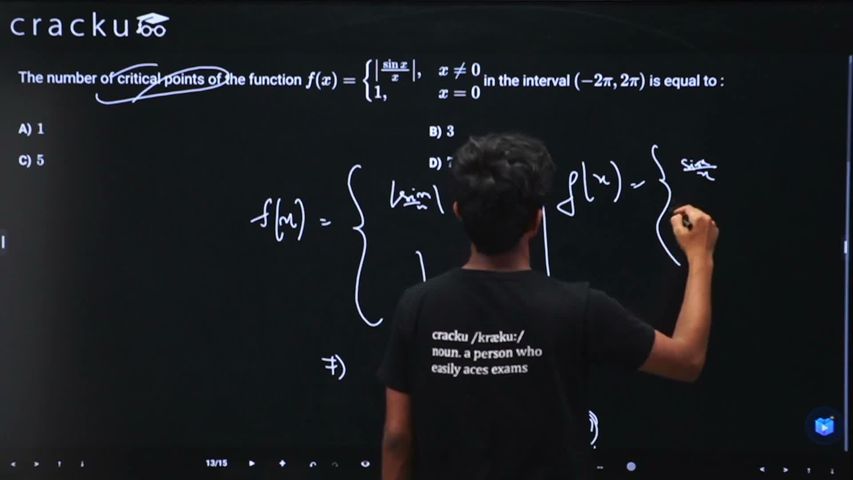
The number of critical points of the function $$f(x) = \begin{cases} \left|\frac{\sin x}{x}\right|, & x \neq 0 \\ 1, & x = 0 \end{cases}$$ in the interval $$(-2\pi, 2\pi)$$ is equal to :
For $$x\neq 0$$ write $$f(x)=\left|\dfrac{\sin x}{x}\right|$$.
Put $$g(x)=\dfrac{\sin x}{x}\;(x\neq 0).$$ Then
$$f(x)=\begin{cases} \;g(x), & g(x)\gt 0\\[2mm] \;-g(x),& g(x)\lt 0 \end{cases}$$
Critical points are those numbers in $$(-2\pi,2\pi)$$ where
(i) $$f'(x)=0$$ (local maxima/minima), or
(ii) $$f'(x)$$ does not exist while $$f$$ is defined (corners/cusps).
1. Points where the derivative can be zero
For regions where $$g(x)\gt 0$$ we have $$f(x)=g(x)$$ and $$f'(x)=g'(x)$$.
For regions where $$g(x)\lt 0$$ we have $$f(x)=-g(x)$$ and $$f'(x)=-g'(x)$$.
Thus $$f'(x)=0$$ exactly where $$g'(x)=0$$ (because $$\pm g'(x)=0$$ gives the same condition).
Differentiate $$g(x)$$ (quotient rule):
$$g'(x)=\dfrac{x\cos x-\sin x}{x^{2}}.$$
Setting the numerator to zero gives
$$x\cos x-\sin x=0\;\Longleftrightarrow\;x=\tan x.$$
Inside $$(-2\pi,2\pi)$$ the equation $$x=\tan x$$ has three solutions:
• $$x=0$$ (trivial root).
• One positive root $$x=c\approx 4.493$$ lying in $$(\pi,\,3\pi/2).$$
• The corresponding negative root $$x=-c\approx -4.493.$$
(There are no other intersections because the straight line $$y=x$$ meets each branch of $$y=\tan x$$ at most once between its vertical asymptotes.)
Hence $$f'(x)=0$$ at $$x=0,\;x=\pm c.$$ That already contributes three critical points.
2. Points where the derivative does not exist but the function is defined
The absolute value creates sharp corners wherever $$g(x)=0$$ (sign change).
Since $$g(x)=\dfrac{\sin x}{x},\;g(x)=0$$ when $$\sin x=0$$ and $$x\neq 0$$; i.e. at $$x=\pm\pi,\;\pm2\pi,\ldots$$
Inside the open interval $$(-2\pi,2\pi)$$ the only such points are $$x=-\pi,\;x=\pi.$$ At both places $$f$$ is continuous but the left- and right-hand derivatives have opposite signs, so $$f'(x)$$ does not exist. Each gives a critical point.
3. Behaviour at $$x=0$$
Although $$g(x)$$ is undefined at the origin, the function is defined by $$f(0)=1.$$ Using $$\sin x=x-\dfrac{x^{3}}{6}+O(x^{5})$$ we get
$$f(x)=\left|\dfrac{\sin x}{x}\right| =\left|1-\dfrac{x^{2}}{6}+O(x^{4})\right| =1-\dfrac{x^{2}}{6}+O(x^{4}).$$
Hence
$$\lim_{h\to 0}\dfrac{f(h)-f(0)}{h} =\lim_{h\to 0}\dfrac{-h^{2}/6+O(h^{4})}{h}=0,$$ so $$f'(0)=0,$$ confirming that $$x=0$$ is already counted as a critical point (from part 1).
4. Total count in $$(-2\pi,2\pi)$$
• From $$f'(x)=0$$: $$x=0,\;\;x=\pm c$$ → 3 points.
• From nondifferentiability: $$x=\pm\pi$$ → 2 points.
Thus the total number of critical points is $$3+2=5$$.
Option C which is: 5
Was this solution helpful?
Click on the Email ☝️ to Watch the Video Solution
Create a FREE account and get:
_1.webp)

Educational materials for JEE preparation

Ask our AI anything

AI can make mistakes. Please verify important information.
AI can make mistakes. Please verify important information.
