
Join Our JEE Preparation Group
Prep with like-minded aspirants; Get access to free daily tests and study material.
Sign in
Please select an account to continue using cracku.in
↓ →
Join Our JEE Preparation Group
Prep with like-minded aspirants; Get access to free daily tests and study material.
If the curve $$y = f(x)$$ passes through the point $$(1, e)$$ and satisfies the differential equation $$dy = y(2 + \log_e x) dx$$, $$x > 0$$, then $$f(e)$$ is equal to :
The given differential equation is
$$dy = y\,(2 + \log_e x)\,dx,\qquad x \gt 0$$
Rewrite it in differential-quotient form:
$$\frac{dy}{dx} = y\,(2 + \log_e x).$$
Separate the variables:
$$\frac{1}{y}\,dy = (2 + \log_e x)\,dx.$$
Integrate both sides:
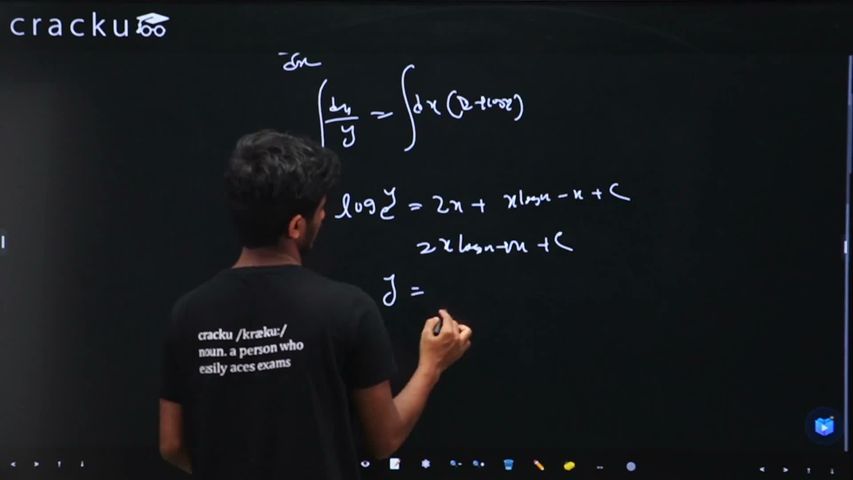
$$\int \frac{1}{y}\,dy = \int (2 + \log_e x)\,dx.$$
The left integral gives $$\log_e y.$$
For the right integral, split it into two parts:
$$\int 2\,dx = 2x,$$
$$\int \log_e x\,dx.$$
Recall the standard result $$\int \log_e x\,dx = x\log_e x - x.$$
Therefore,
$$\int (2 + \log_e x)\,dx = 2x + \bigl(x\log_e x - x\bigr) = x\log_e x + x.$$
Combining the two integrals:
$$\log_e y = x\log_e x + x + C \qquad -(1)$$
where $$C$$ is the constant of integration.
Exponentiate both sides to solve for $$y$$:
$$y = e^{\,x\log_e x + x + C} = e^{C}\,e^{x\log_e x}\,e^{x}.$$
Write $$e^{C}$$ as a new constant $$K$$:
$$y = K\,x^{x}\,e^{x} \qquad -(2)$$
(because $$e^{x\log_e x} = x^{x}$$).
Use the point $$(1,\,e)$$ that lies on the curve to find $$K$$.
Substitute $$x = 1,\; y = e$$ in $$(2)$$:
$$e = K\,(1)^{1}\,e^{1} = K\,e.$$
Hence $$K = 1.$$
The required function is therefore
$$f(x) = x^{x}\,e^{x}.$$
Finally, evaluate $$f(e)$$:
$$f(e) = e^{e}\,e^{e} = e^{2e}.$$
Thus, $$f(e) = e^{2e}.$$
Option C which is: $$e^{2e}$$
Was this solution helpful?
Click on the Email ☝️ to Watch the Video Solution
Create a FREE account and get:
_1.webp)

Educational materials for JEE preparation

Ask our AI anything

AI can make mistakes. Please verify important information.
AI can make mistakes. Please verify important information.
