
Join Our JEE Preparation Group
Prep with like-minded aspirants; Get access to free daily tests and study material.
Sign in
Please select an account to continue using cracku.in
↓ →
Join Our JEE Preparation Group
Prep with like-minded aspirants; Get access to free daily tests and study material.
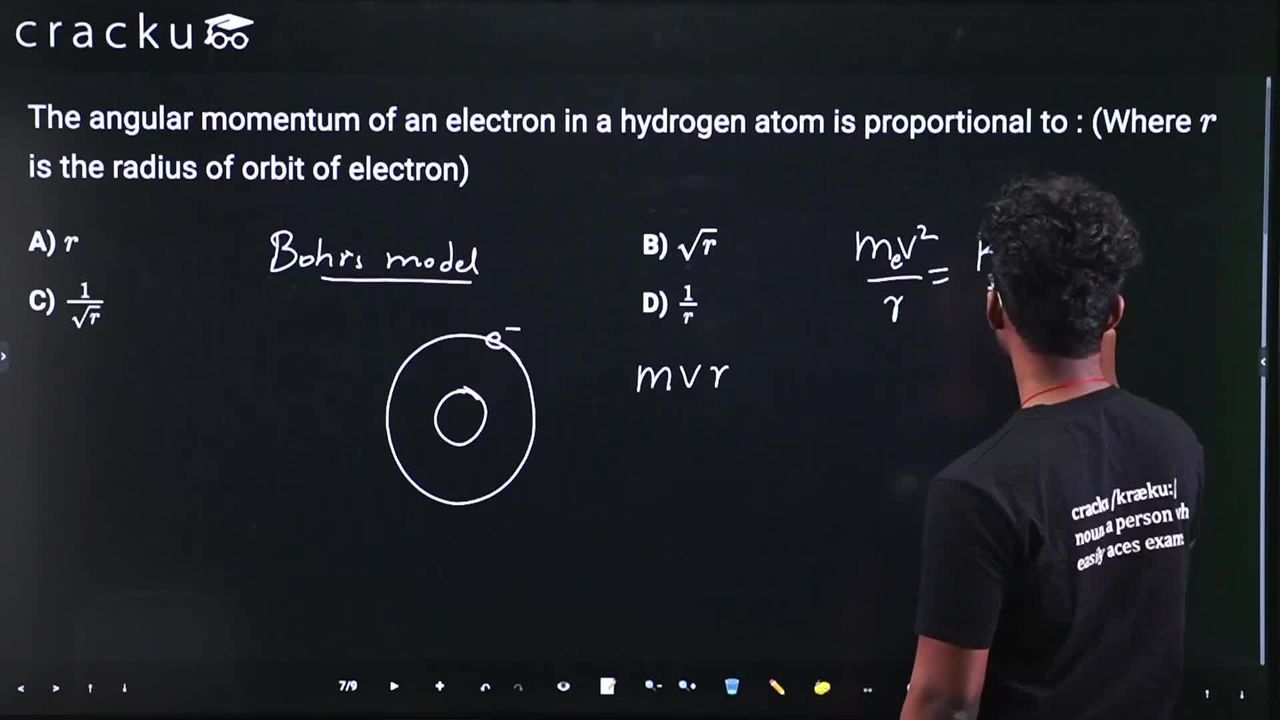
The angular momentum of an electron in a hydrogen atom is proportional to : (Where $$r$$ is the radius of orbit of electron)
We need to find how the angular momentum of an electron in a hydrogen atom depends on the radius of its orbit, using the Bohr model.
In Bohr's model, the angular momentum of the electron in the $$n$$-th orbit is quantised: $$L = mvr = n\hbar = \frac{nh}{2\pi}$$, where $$n$$ is the principal quantum number ($$n = 1, 2, 3, \ldots$$), $$m$$ is the electron mass, $$v$$ is the orbital speed, and $$r$$ is the orbital radius. This tells us that $$L \propto n$$.
In the Bohr model, the radius of the $$n$$-th orbit for hydrogen is given by $$r_n = a_0 n^2$$, where $$a_0 = 0.529$$ Angstrom is the Bohr radius, which shows that $$r \propto n^2$$.
From $$r \propto n^2$$, we can write $$n \propto \sqrt{r}$$.
Since $$L \propto n$$ and $$n \propto \sqrt{r}$$, it follows that $$L \propto \sqrt{r}$$.
The correct answer is Option (2): $$\sqrt{r}$$.
Was this solution helpful?
Click on the Email ☝️ to Watch the Video Solution
Create a FREE account and get:
_1.webp)

Educational materials for JEE preparation

Ask our AI anything

AI can make mistakes. Please verify important information.
AI can make mistakes. Please verify important information.
