
Join Our JEE Preparation Group
Prep with like-minded aspirants; Get access to free daily tests and study material.
Sign in
Please select an account to continue using cracku.in
↓ →
Join Our JEE Preparation Group
Prep with like-minded aspirants; Get access to free daily tests and study material.
Question: Which statement about stopping potential ($$V_0$$) is NOT true?
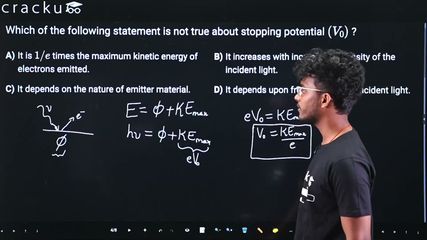
In the photoelectric effect, the stopping potential $$V_0$$ is the minimum reverse potential needed to stop the most energetic photoelectrons. From Einstein's photoelectric equation: $$eV_0 = h\nu - \phi$$ where $$h$$ is Planck's constant, $$\nu$$ is the frequency of incident light, and $$\phi$$ is the work function of the metal.
Option 1: "It is $$\frac{1}{e}$$ times the maximum kinetic energy of electrons emitted." Since $$V_0 = \frac{KE_{max}}{e}$$, this is true by definition.
Option 2: "It increases with increase in intensity of the incident light." The stopping potential depends only on the frequency of light, not its intensity. Increasing intensity increases the number of photoelectrons (photocurrent) but does not change the maximum kinetic energy or stopping potential. This statement is NOT true.
Option 3: "It depends on the nature of emitter material." From $$V_0 = \frac{h\nu - \phi}{e}$$, and since the work function $$\phi$$ depends on the material, $$V_0$$ does depend on the emitter material. This is true.
Option 4: "It depends upon frequency of the incident light." From the equation, $$V_0$$ clearly depends on $$\nu$$. This is true.
The statement that is NOT true is Option 2.
Was this solution helpful?
Click on the Email ☝️ to Watch the Video Solution
Create a FREE account and get:
_1.webp)

Educational materials for JEE preparation

Ask our AI anything

AI can make mistakes. Please verify important information.
AI can make mistakes. Please verify important information.
