
Join Our JEE Preparation Group
Prep with like-minded aspirants; Get access to free daily tests and study material.
Sign in
Please select an account to continue using cracku.in
↓ →
Join Our JEE Preparation Group
Prep with like-minded aspirants; Get access to free daily tests and study material.
In the given circuit diagram, the currents, $$I_1 = -0.3$$ A, $$I_4 = 0.8$$ A and $$I_5 = 0.4$$ A, are flowing as shown. The currents $$I_2$$, $$I_3$$ and $$I_6$$, respectively, are:
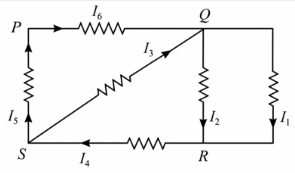
First we recall Kirchhoff’s Current Law (KCL): at any junction the algebraic sum of currents is zero, i.e. the total current flowing into the junction equals the total current flowing out of the junction.
Look at the top junction (call it P) where the three branches carrying $$I_1,\; I_2$$ and $$I_4$$ meet. In the figure the arrow of $$I_4$$ is directed towards the junction while the arrows of $$I_1$$ and $$I_2$$ are directed away from it. Applying KCL, the current that reaches the junction along $$I_4$$ must leave through the other two branches, so we write
$$I_4 \;=\; I_1 + I_2.$$
We directly substitute the given numerical values $$I_1 = -0.3\,\text{A}$$ and $$I_4 = 0.8\,\text{A}$$:
$$0.8 \;=\; -0.3 + I_2.$$
Solving for $$I_2$$ gives
$$I_2 \;=\; 0.8 - (-0.3) \;=\; 0.8 + 0.3 \;=\; 1.1 \,\text{A}.$$
Now we move to the next junction (call it Q) where the current $$I_4$$ divides into the two branch currents $$I_5$$ and $$I_6$$. Both $$I_5$$ and $$I_6$$ flow away from the junction, while $$I_4$$ flows toward it. Again applying KCL,
$$I_4 \;=\; I_5 + I_6.$$
Putting $$I_4 = 0.8\,\text{A}$$ and $$I_5 = 0.4\,\text{A},$$ we get
$$0.8 \;=\; 0.4 + I_6,$$
which immediately yields
$$I_6 \;=\; 0.8 - 0.4 \;=\; 0.4 \,\text{A}.$$
Finally, observe the straight continuous conductor between the junctions carrying currents $$I_5$$ and $$I_3$$. Because there is no additional branch between those two points, the same current must flow through the entire segment; therefore
$$I_3 \;=\; I_5 \;=\; 0.4 \,\text{A}.$$
Collecting all the obtained results we have
$$I_2 = 1.1\,\text{A}, \qquad I_3 = 0.4\,\text{A}, \qquad I_6 = 0.4\,\text{A}.$$
Hence, the correct answer is Option C.
Was this solution helpful?
Create a FREE account and get:
_1.webp)

Educational materials for JEE preparation

Ask our AI anything

AI can make mistakes. Please verify important information.
AI can make mistakes. Please verify important information.


