
Join Our JEE Preparation Group
Prep with like-minded aspirants; Get access to free daily tests and study material.
Sign in
Please select an account to continue using cracku.in
↓ →
Join Our JEE Preparation Group
Prep with like-minded aspirants; Get access to free daily tests and study material.
In a scattering experiment, a particle of mass $$2m$$ collides with another particle of mass $$m$$, which is initially at rest. Assuming the collision to be perfectly elastic, the maximum angular deviation $$\theta$$ of the heavier particle, as shown in the figure, in radians is:
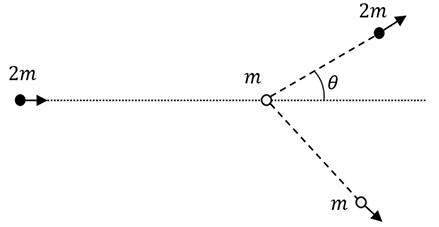
Let the incident (heavier) particle have mass $$m_1 = 2m$$ and initial speed $$u$$ along the +x-axis. The target particle has mass $$m_2 = m$$ and is initially at rest in the laboratory (lab) frame.
Step 1: Velocity of the centre of mass (COM)
$$V = \frac{m_1 u + m_2 \times 0}{m_1 + m_2}
= \frac{2m\,u}{2m+m}
= \frac{2u}{3}$$
Step 2: Velocities in the COM frame before collision
Velocity of $$m_1$$ in COM frame:
$$u_{1c} = u - V = u - \frac{2u}{3} = \frac{u}{3}$$ (along +x)
Magnitude of this velocity: $$|u_{1c}| = \frac{u}{3}$$
Step 3: Velocities in the COM frame after an elastic collision
In a perfectly elastic, two-body collision the magnitudes of the velocities in the COM frame remain unchanged; only their directions change.
Hence the heavier particle still has speed $$\dfrac{u}{3}$$ in the COM frame, but its direction makes some angle $$\phi$$ with the +x-axis.
Write the post-collision COM-frame velocity of $$m_1$$ as $$\vec{u}_{1c}' = \frac{u}{3}\bigl(\cos\phi\,\hat{i} + \sin\phi\,\hat{j}\bigr)$$
Step 4: Transform back to the lab frame
Lab-frame velocity of $$m_1$$ after collision:
$$\vec{v}_{1}' = \vec{V} + \vec{u}_{1c}'
= \frac{2u}{3}\,\hat{i} + \frac{u}{3}\bigl(\cos\phi\,\hat{i} + \sin\phi\,\hat{j}\bigr)$$
Components:
$$v_{x} = \frac{2u}{3} + \frac{u}{3}\cos\phi$$
$$v_{y} = \frac{u}{3}\sin\phi$$
Step 5: Angular deviation of the heavier particle
Let $$\theta$$ be the angle between $$\vec{v}_{1}'$$ and the initial direction (+x). Then
$$\tan\theta = \frac{v_{y}}{v_{x}}
= \frac{\dfrac{u}{3}\sin\phi}{\dfrac{2u}{3} + \dfrac{u}{3}\cos\phi}
= \frac{\sin\phi}{2 + \cos\phi} \quad -(1)$$
Step 6: Maximising $$\theta$$
Because $$0 \lt \theta \lt \dfrac{\pi}{2}$$, maximising $$\theta$$ is equivalent to maximising $$\tan\theta$$.
Define $$f(\phi) = \dfrac{\sin\phi}{2 + \cos\phi}$$.
Differentiating and setting $$\dfrac{df}{d\phi}=0$$ gives $$\frac{df}{d\phi} = \frac{\cos\phi(2+\cos\phi) + \sin^{2}\phi}{(2+\cos\phi)^{2}} = \frac{2\cos\phi + \cos^{2}\phi + \sin^{2}\phi}{(2+\cos\phi)^{2}} = \frac{2\cos\phi + 1}{(2+\cos\phi)^{2}}$$
Setting the numerator to zero:
$$2\cos\phi + 1 = 0 \;\;\Longrightarrow\;\; \cos\phi = -\frac{1}{2}
\;\;\Longrightarrow\;\; \phi = \frac{2\pi}{3}$$
(Only the value within $$0 \le \phi \le \pi$$ is relevant.)
For $$\phi \lt \dfrac{2\pi}{3}$$, the derivative is positive and for $$\phi \gt \dfrac{2\pi}{3}$$ it is negative, so $$\phi = \dfrac{2\pi}{3}$$ indeed gives the maximum.
Step 7: Maximum value of $$\theta$$
Insert $$\phi = \dfrac{2\pi}{3}$$ into equation $$(1)$$:
$$\tan\theta_{\max} = \frac{\sin(2\pi/3)}{2 + \cos(2\pi/3)}
= \frac{\dfrac{\sqrt{3}}{2}}{2 - \dfrac{1}{2}}
= \frac{\dfrac{\sqrt{3}}{2}}{\dfrac{3}{2}}
= \frac{\sqrt{3}}{3}
= \frac{1}{\sqrt{3}}$$
Therefore $$\theta_{\max} = \tan^{-1}\!\left(\frac{1}{\sqrt{3}}\right) = \frac{\pi}{6}$$
Option D which is: $$\dfrac{\pi}{6}$$
Was this solution helpful?
Create a FREE account and get:
_1.webp)

Educational materials for JEE preparation

Ask our AI anything

AI can make mistakes. Please verify important information.
AI can make mistakes. Please verify important information.
