
Join Our JEE Preparation Group
Prep with like-minded aspirants; Get access to free daily tests and study material.
Sign in
Please select an account to continue using cracku.in
↓ →
Join Our JEE Preparation Group
Prep with like-minded aspirants; Get access to free daily tests and study material.
The center of a disk of radius $$r$$ and mass $$m$$ is attached to a spring of spring constant $$k$$, inside a ring of radius $$R > r$$ as shown in the figure. The other end of the spring is attached on the periphery of the ring. Both the ring and the disk are in the same vertical plane. The disk can only roll along the inside periphery of the ring, without slipping. The spring can only be stretched or compressed along the periphery of the ring, following the Hooke's law. In equilibrium, the disk is at the bottom of the ring. Assuming small displacement of the disc, the time period of oscillation of center of mass of the disk is written as $$T = \frac{2\pi}{\omega}$$. The correct expression for $$\omega$$ is ($$g$$ is the acceleration due to gravity):
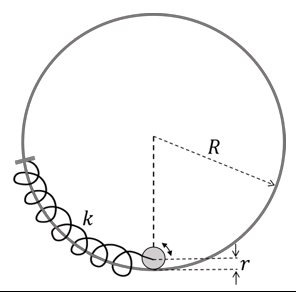
Let the centre of the ring be $$O$$ and let the centre of the disk be $$C$$. Because the disk rolls without slipping on the inner wall of the ring, the distance $$OC$$ remains constant and is equal to the inner radius available for the centre,
$$a = R - r$$
Choose the small angular displacement $$\theta$$ of the centre $$C$$ from the lowest (vertical) position as the generalised coordinate. Arc‐length travelled by the centre is then
$$s = a\theta \qquad (|\theta| \ll 1)$$
1. Constraint of pure rolling
Pure rolling gives a fixed relation between the translational speed of the centre and the angular speed of the disk about its own axis:
$$v_{\text{cm}} = a\dot\theta = r\dot\phi \qquad -(1)$$
where $$\dot\phi$$ is the angular velocity of the disk about its diameter.
2. Kinetic energy
Translational kinetic energy:
$$T_{\text{trans}} = \tfrac12 m v_{\text{cm}}^{2} = \tfrac12 m (a\dot\theta)^{2}$$
Moment of inertia of a solid disk about its centre: $$I = \tfrac12 m r^{2}$$
Using the rolling relation $$(1)$$, rotational kinetic energy is
$$T_{\text{rot}} = \tfrac12 I\dot\phi^{2} = \tfrac12\!\left(\tfrac12 m r^{2}\right)\! \left(\tfrac{a\dot\theta}{r}\right)^{2} = \tfrac14 m a^{2}\dot\theta^{2}$$
Thus total kinetic energy is
$$T = T_{\text{trans}} + T_{\text{rot}} = \left(\tfrac12 + \tfrac14\right)m a^{2}\dot\theta^{2} = \tfrac34 m a^{2}\dot\theta^{2} \qquad -(2)$$
3. Potential energy
(i) Gravitational: For a small angular displacement, the rise in the centre’s height is $$h = a(1-\cos\theta) \approx \tfrac12 a\theta^{2}$$ Therefore
$$U_g = mgh = \tfrac12 m g a\theta^{2} \qquad -(3)$$
(ii) Spring: The spring is attached tangentially along the periphery, so its extension/compression equals the arc length $$s = a\theta$$. Hooke’s law gives
$$U_s = \tfrac12 k s^{2} = \tfrac12 k a^{2}\theta^{2} \qquad -(4)$$
Total potential energy: $$U = U_g + U_s$$
$$U = \tfrac12\left(m g a + k a^{2}\right)\theta^{2} \qquad -(5)$$
4. Small-oscillation equation
Using the Lagrangian $$L = T - U$$ with $$T$$ from $$(2)$$ and $$U$$ from $$(5)$$:
$$L = \tfrac34 m a^{2}\dot\theta^{2} - \tfrac12\left(m g a + k a^{2}\right)\theta^{2}$$
Applying the Euler-Lagrange equation $$\frac{d}{dt}\left(\frac{\partial L}{\partial\dot\theta}\right) - \frac{\partial L}{\partial\theta}=0$$ gives
$$\frac{d}{dt}\!\left(\tfrac34\cdot 2 m a^{2}\dot\theta\right) + \left(m g a + k a^{2}\right)\theta = 0$$
$$\tfrac32 m a^{2}\ddot\theta + m g a\theta + k a^{2}\theta = 0 \qquad -(6)$$
Divide by $$\tfrac32 m a^{2}$$:
$$\ddot\theta + \left[\frac{2}{3}\left(\frac{g}{a} + \frac{k}{m}\right)\right]\theta = 0$$
This is the standard SHM form $$\ddot\theta + \omega^{2}\theta = 0$$ with
$$\omega^{2} = \frac{2}{3}\left(\frac{g}{a} + \frac{k}{m}\right) = \frac{2}{3}\left(\frac{g}{R - r} + \frac{k}{m}\right) \qquad -(7)$$
5. Time period
$$T = \frac{2\pi}{\omega}$$ with $$\omega$$ given by $$(7)$$.
Hence the correct expression is
$$\boxed{\displaystyle \omega = \sqrt{\frac{2}{3}\left(\frac{g}{R-r} + \frac{k}{m}\right)}}$$
Option A perfectly matches this result.
Create a FREE account and get:
_1.webp)

Educational materials for JEE preparation

Ask our AI anything

AI can make mistakes. Please verify important information.
AI can make mistakes. Please verify important information.


