
Join Our JEE Preparation Group
Prep with like-minded aspirants; Get access to free daily tests and study material.
Sign in
Please select an account to continue using cracku.in
↓ →
Join Our JEE Preparation Group
Prep with like-minded aspirants; Get access to free daily tests and study material.
Let $$\vec{w} = \hat{i} + \hat{j} - 2\hat{k}$$, and $$\vec{u}$$ and $$\vec{v}$$ be two vectors, such that $$\vec{u} \times \vec{v} = \vec{w}$$ and $$\vec{v} \times \vec{w} = \vec{u}$$. Let $$\alpha, \beta, \gamma$$, and $$t$$ be real numbers such that
$$\vec{u} = \alpha\hat{i} + \beta\hat{j} + \gamma\hat{k}, \quad -t\alpha + \beta + \gamma = 0, \quad \alpha - t\beta + \gamma = 0, \quad \text{and} \quad \alpha + \beta - t\gamma = 0.$$
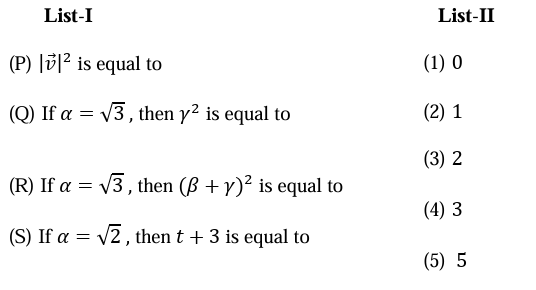
Match each entry in List-I to the correct entry in List-II and choose the correct option.
The three vectors are connected by
$$\vec{u}\times\vec{v}= \vec{w},\qquad \vec{v}\times\vec{w}= \vec{u},\qquad \vec{w}= \hat{i}+ \hat{j}-2\hat{k}.$$
The cross-product of two vectors is perpendicular to each of them, so
$$\vec{u}\cdot\vec{v}=0, \qquad \vec{v}\cdot\vec{w}=0, \qquad \vec{w}\cdot\vec{u}=0.$$
Hence the three vectors are pair-wise perpendicular.
Magnitude of $$\vec{w}$$:
$$|\vec{w}|^{2}=1^{2}+1^{2}+(-2)^{2}=6.$$
Using the identity $$|\vec{a}\times\vec{b}|^{2}=|\,\vec{a}\,|^{2}|\,\vec{b}\,|^{2}-(\vec{a}\cdot\vec{b})^{2},$$
$$|\vec{w}|^{2}=|\vec{u}\times\vec{v}|^{2}=|\vec{u}|^{2}|\vec{v}|^{2}\quad(\because\vec{u}\cdot\vec{v}=0)$$
and
$$|\vec{u}|^{2}=|\vec{v}\times\vec{w}|^{2}=|\vec{v}|^{2}|\vec{w}|^{2}\quad(\because\vec{v}\cdot\vec{w}=0).$$
Let $$|\vec{u}|^{2}=a,\; |\vec{v}|^{2}=b.$$
Then $$6=ab \quad\text{and}\quad a=6b.$$
Substituting, $$6=(6b)b\;\Longrightarrow\; b^{2}=1\;\Longrightarrow\; b=1.$$
Therefore
Case P: $$|\vec{v}|^{2}=1\; \Rightarrow\; (P)\to(2).$$
The components of $$\vec{u}=\alpha\hat{i}+\beta\hat{j}+\gamma\hat{k}$$ obey the three equations
$$-t\alpha+\beta+\gamma=0\; -(1)$$
$$\alpha-t\beta+\gamma=0\; -(2)$$
$$\alpha+\beta-t\gamma=0\; -(3).$$
For a non-trivial solution, the determinant of the coefficient matrix must vanish:
$$\begin{vmatrix}-t&1&1\\[2pt]1&-t&1\\[2pt]1&1&-t\end{vmatrix}=0 \;\Longrightarrow\; -t^{3}+3t+2=0 \;\Longrightarrow\; t^{3}-3t-2=0 =(t-2)(t+1)^{2}=0.$$
Thus $$t=2\quad\text{or}\quad t=-1.$$ We must also satisfy $$\vec{w}\cdot\vec{u}=0\;\Rightarrow\; \alpha+\beta-2\gamma=0\; -(4).$$
Taking $$t=-1$$
Equations (1)-(3) all reduce to $$\alpha+\beta+\gamma=0.$$
With $$\alpha=\sqrt{3}$$,
$$\beta+\gamma=-\sqrt{3}\; -(5).$$
Using (4): $$\sqrt{3}+\beta-2\gamma=0
\;\Longrightarrow\;
-3\gamma=0
\;\Longrightarrow\;
\gamma=0,\;\beta=-\sqrt{3}.$$
Hence
Case Q: $$\gamma^{2}=0\;\Rightarrow\; (Q)\to(1).$$
Case R: $$(\beta+\gamma)^{2}=(-\sqrt{3})^{2}=3\;\Rightarrow\; (R)\to(4).$$
Taking $$t=2$$
From (1): $$\beta=2\alpha-\gamma.$$
From (2): $$\alpha-2\beta+\gamma=0
\;\Longrightarrow\;
\gamma=\alpha.$$
Therefore $$\beta=\alpha.$$
With $$\alpha=\sqrt{2}$$ we get $$t=2,$$ hence
Case S: $$t+3=2+3=5\;\Rightarrow\; (S)\to(5).$$
Collecting all matches:
(P)$$\to$$(2), (Q)$$\to$$(1), (R)$$\to$$(4), (S)$$\to$$(5).
Thus the correct option is
Option A which is: (P)$$\to$$(2), (Q)$$\to$$(1), (R)$$\to$$(4), (S)$$\to$$(5).
Create a FREE account and get:
_1.webp)

Educational materials for JEE preparation

Ask our AI anything

AI can make mistakes. Please verify important information.
AI can make mistakes. Please verify important information.


