
Join Our JEE Preparation Group
Prep with like-minded aspirants; Get access to free daily tests and study material.
Sign in
Please select an account to continue using cracku.in
↓ →
Join Our JEE Preparation Group
Prep with like-minded aspirants; Get access to free daily tests and study material.
Let $$\mathbb{R}$$ denote the set of all real numbers. For a real number $$x$$, let $$[x]$$ denote the greatest integer less than or equal to $$x$$. Let $$n$$ denote a natural number.
Match each entry in List-I to the correct entry in List-II and choose the correct option.
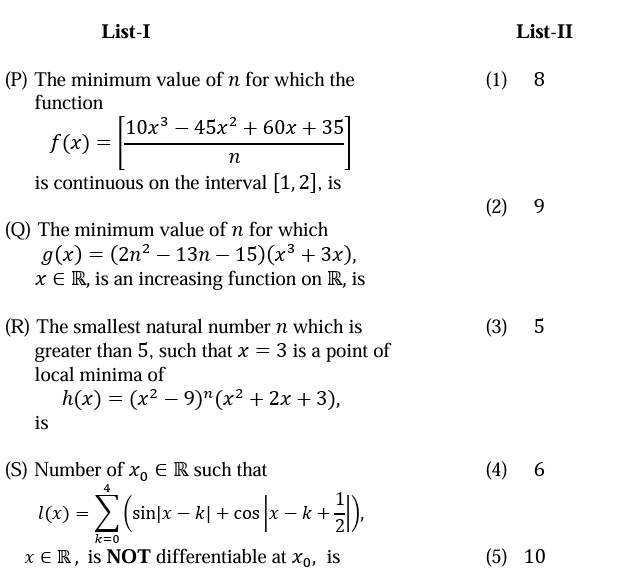
Case P: We need the smallest natural number $$n$$ such that the function $$f(x)=\left[\dfrac{10x^{3}-45x^{2}+60x+35}{n}\right]$$ is continuous on $$[1,2]$$.
The inner polynomial is $$p(x)=10x^{3}-45x^{2}+60x+35$$.
Evaluate at the end-points:
$$p(1)=10-45+60+35=60,\qquad p(2)=80-180+120+35=55.$$
Since $$p'(x)=30(x-1)(x-2)$$ is negative for $$1\lt x\lt 2,$$ $$p(x)$$ decreases strictly from $$60$$ to $$55$$, so on $$[1,2]$$ we have$$55\le p(x)\le 60.$$(The full range is actually $$[55,60]$$.)
Hence $$\dfrac{p(x)}{n}$$ lies in $$\left[\dfrac{55}{n},\dfrac{60}{n}\right]$$. For $$f(x)=[p(x)/n]$$ to be continuous, the entire interval $$[55/n,\,60/n]$$ must be contained in one open interval $$(k,k+1)$$ for some integer $$k$$ (otherwise the greatest-integer function jumps inside $$[1,2]$$).
The length of this interval is $$\dfrac{60-55}{n}=\dfrac{5}{n},$$ so we first need $$\dfrac{5}{n}\lt 1\;\Longrightarrow\;n\gt 5.$$ Now test successive natural numbers $$n\gt 5$$.
• $$n=6:\;[55/6,60/6]=[9.166\ldots,10].$$ The right end equals an integer; $$f(x)$$ jumps at $$x=1$$, so discontinuous.
• $$n=7:\;[7.857\ldots,8.571\ldots]$$ crosses the integer $$8$$ ⇒ discontinuous.
• $$n=8:\;[6.875,7.5]$$ crosses the integer $$7$$ ⇒ discontinuous.
• $$n=9:\;[6.111\ldots,6.666\ldots]\subset(6,7).$$ No integer is touched; hence $$f(x)$$ is continuous.
Thus the minimum $$n$$ is $$9$$. In List-II the number $$9$$ is entry (2). So (P) → (2).
Case Q: For $$g(x)=(2n^{2}-13n-15)(x^{3}+3x)$$ to be increasing on all $$\mathbb{R}$$ we need $$g'(x)\ge 0$$ everywhere.
$$g'(x)=(2n^{2}-13n-15)\bigl(3x^{2}+3\bigr)=3(2n^{2}-13n-15)(x^{2}+1).$$ Since $$x^{2}+1\gt 0$$ for all $$x,$$ the sign of $$g'(x)$$ is governed by $$A(n)=2n^{2}-13n-15.$$ Set $$A(n)\gt 0$$:
$$2n^{2}-13n-15\gt 0.$$
The roots of $$2n^{2}-13n-15=0$$ are $$n=\dfrac{13\pm\sqrt{169+120}}{4}=\dfrac{13\pm17}{4}\; \Rightarrow\; n=-1,\;7.5.$$ The quadratic is positive for $$n\gt 7.5$$ (or $$n\lt -1$$, which is irrelevant here). Hence the least natural $$n$$ making $$g$$ increasing is $$n=8$$.
Entry $$8$$ is (1) in List-II. So (Q) → (1).
Case R: We need the smallest natural $$n\gt 5$$ such that $$x=3$$ is a point of local minima of $$h(x)=(x^{2}-9)^{n}(x^{2}+2x+3).$$
Notice $$(x^{2}-9)^{n}=(x-3)^{n}(x+3)^{n},$$ and near $$x=3,$$ the factor $$(x+3)^{n}(x^{2}+2x+3)$$ is positive (its value at $$x=3$$ is $$6^{n}\cdot18\gt 0$$). Thus near $$x=3$$, $$h(x)$$ behaves like a positive constant times $$(x-3)^{n}$$.
• If $$n$$ is odd, $$(x-3)^{n}$$ changes sign about $$x=3$$, so $$x=3$$ is neither a local minimum nor a maximum.
• If $$n$$ is even, $$(x-3)^{n}\ge 0$$ with a zero at $$x=3$$ and positive values on both sides, giving a local minimum.
Therefore $$n$$ must be the smallest even natural number $$\gt 5,$$ i.e. $$n=6$$.
Entry $$6$$ is (4) in List-II. So (R) → (4).
Case S: Define $$l(x)=\sum_{k=0}^{4}\Bigl(\sin|x-k|+\cos\bigl|x-k+\tfrac12\bigr|\Bigr).$$ A finite sum is nondifferentiable exactly where at least one summand is nondifferentiable.
1. $$\sin|t|$$ is nondifferentiable at $$t=0$$ because $$\dfrac{d}{dt}\sin|t|=\cos|t|\operatorname{sgn}(t),$$ whose one-sided limits at $$t=0$$ are $$+1$$ and $$-1$$.
2. $$\cos|t|$$ is differentiable everywhere since $$\dfrac{d}{dt}\cos|t|=-\sin|t|\operatorname{sgn}(t),$$ and both one-sided limits at $$t=0$$ are $$0$$.
Hence nondifferentiability of $$l(x)$$ occurs only where $$|x-k|=0$$, i.e. at $$x=k,\quad k=0,1,2,3,4.$$ (The cos-terms never introduce new singularities.)
Thus there are $$5$$ real numbers $$x_{0}$$ at which $$l(x)$$ is not differentiable.
Entry $$5$$ in List-II corresponds to the number $$5$$. So (S) → (3).
Collecting all the matches:
(P) → (2), (Q) → (1), (R) → (4), (S) → (3).
Therefore the correct option is:
Option B which is: (P)→(2), (Q)→(1), (R)→(4), (S)→(3).
Create a FREE account and get:
_1.webp)

Educational materials for JEE preparation

Ask our AI anything

AI can make mistakes. Please verify important information.
AI can make mistakes. Please verify important information.


