
Join Our JEE Preparation Group
Prep with like-minded aspirants; Get access to free daily tests and study material.
Sign in
Please select an account to continue using cracku.in
↓ →
Join Our JEE Preparation Group
Prep with like-minded aspirants; Get access to free daily tests and study material.
Find the distance of the image from object $$O$$, formed by the combination of lenses in the figure:
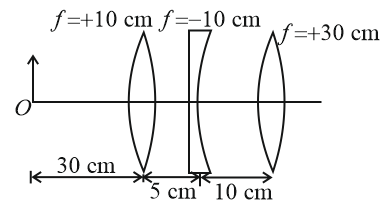
We need to find the total distance between the object $$O$$ and the final image produced by the combination of three thin lenses.
The object $$O$$ is placed to the left of the first convex lens ($$f_1 = +10\text{ cm}$$) at a distance of $$30\text{ cm}$$.
Applying the standard Lens Formula:
$$\frac{1}{v_1} - \frac{1}{u_1} = \frac{1}{f_1}$$
$$\frac{1}{v_1} - \frac{1}{-30} = \frac{1}{10} \implies \frac{1}{v_1} = \frac{1}{10} - \frac{1}{30}$$
$$\frac{1}{v_1} = \frac{3 - 1}{30} = \frac{2}{30} \implies v_1 = +15\text{ cm}$$
The first lens forms a real image $$15\text{ cm}$$ to its right.
The second lens ($$f_2 = -10\text{ cm}$$) is placed $$5\text{ cm}$$ to the right of the first lens. The image from the first lens acts as a virtual object for this second lens.
Applying the Lens Formula for the second stage:
$$\frac{1}{v_2} - \frac{1}{u_2} = \frac{1}{f_2}$$
$$\frac{1}{v_2} - \frac{1}{10} = \frac{1}{-10} \implies \frac{1}{v_2} = -\frac{1}{10} + \frac{1}{10} = 0$$
$$v_2 = \infty$$
The light rays emerge completely parallel to the principal axis after passing through the second lens.
The third lens ($$f_3 = +30\text{ cm}$$) is placed $$10\text{ cm}$$ to the right of the second lens. Since the incoming rays are traveling parallel to the principal axis ($$u_3 = \infty$$), they must naturally converge at its focus.
Applying the Lens Formula for the final stage:
$$\frac{1}{v_3} - \frac{1}{\infty} = \frac{1}{30} \implies v_3 = +30\text{ cm}$$
The final image is formed at a distance of $$30\text{ cm}$$ to the right of the third lens.
The total geometric separation distance ($D$) across the entire setup is the sum of the initial object distance, all gaps between the lenses, and the final image distance:
$$D = (\text{Distance of } O \text{ to Lens 1}) + (\text{Gap 1}) + (\text{Gap 2}) + (\text{Distance of final image from Lens 3})$$
$$D = 30\text{ cm} + 5\text{ cm} + 10\text{ cm} + 30\text{ cm} = 75\text{ cm}$$
Final Answer: 75 cm
Was this solution helpful?
Create a FREE account and get:
_1.webp)

Educational materials for JEE preparation

Ask our AI anything

AI can make mistakes. Please verify important information.
AI can make mistakes. Please verify important information.
