
Join Our JEE Preparation Group
Prep with like-minded aspirants; Get access to free daily tests and study material.
Sign in
Please select an account to continue using cracku.in
↓ →
Join Our JEE Preparation Group
Prep with like-minded aspirants; Get access to free daily tests and study material.
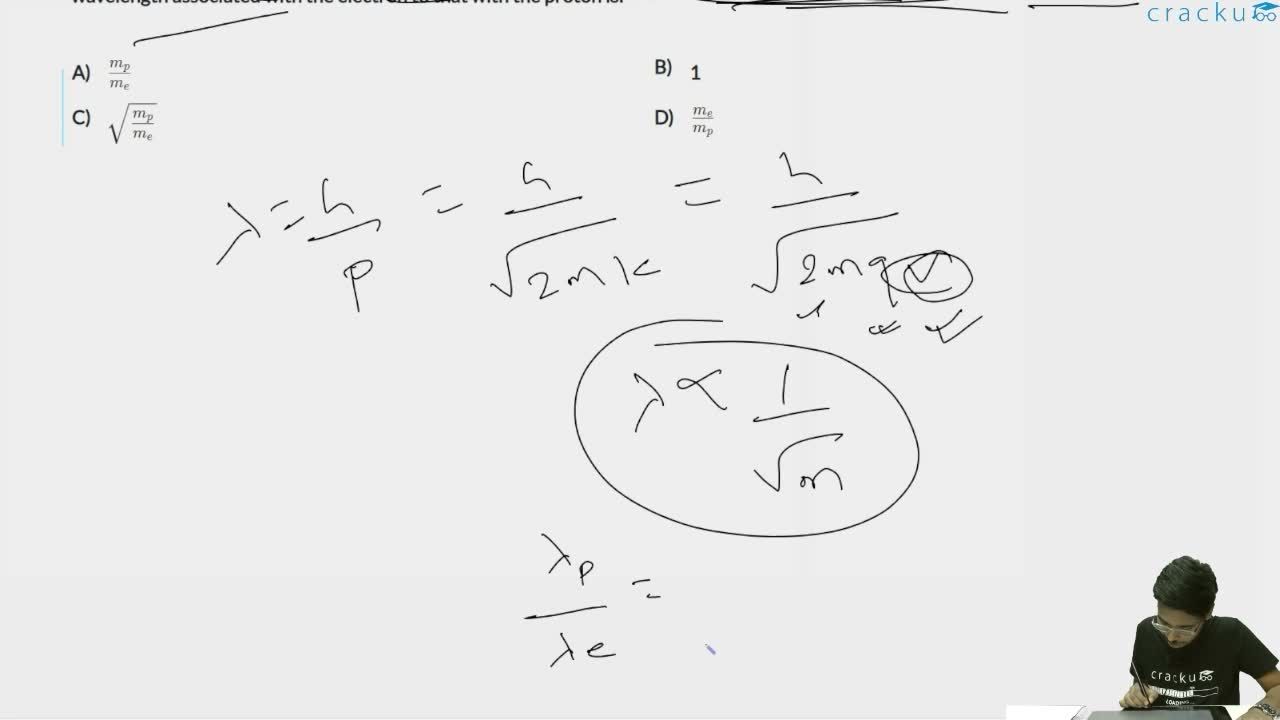
An electron of mass $$m_e$$ and a proton of mass $$m_P$$ are accelerated through the same potential difference. The ratio of the de-Broglie wavelength associated with the electron to that with the proton is:
We need to find the ratio of the de-Broglie wavelength associated with an electron to that with a proton when both are accelerated through the same potential difference.
According to de-Broglie's hypothesis, a moving particle behaves as a wave, and its wavelength ($\lambda$) is given by:
$$\lambda = \frac{h}{p}$$
Where:
When a particle of charge $$q$$ and mass $$m$$ is accelerated from rest through a potential difference $$V$$, the kinetic energy ($$K$$) gained by the particle is:
$$K = qV$$
We also know that kinetic energy is related to momentum ($$p$$) by the formula:
$$K = \frac{p^2}{2m} \implies p = \sqrt{2mK}$$
Substituting the kinetic energy equation ($$K = qV$$) into the momentum formula gives:
$$p = \sqrt{2mqV}$$
Now, substitute the expression for momentum ($$p$$) back into the de-Broglie wavelength formula:
$$\lambda = \frac{h}{\sqrt{2mqV}}$$
Let's write out the wavelengths for both the electron and the proton:
$$\lambda_e = \frac{h}{\sqrt{2m_e eV}}$$
$$\lambda_p = \frac{h}{\sqrt{2m_p eV}}$$
(Note: Both the electron and proton have the same magnitude of charge $$q = e$$ and are accelerated through the same potential difference $$V$$.)
Taking the ratio of the de-Broglie wavelength of the electron to that of the proton:
$$\frac{\lambda_e}{\lambda_p} = \frac{\frac{h}{\sqrt{2m_e eV}}}{\frac{h}{\sqrt{2m_p eV}}}$$
Canceling out the common terms ($$h$$, $$2$$, $$e$$, and $$V$$), the equation simplifies inversely to the square root of their masses:
$$\frac{\lambda_e}{\lambda_p} = \sqrt{\frac{m_p}{m_e}}$$
Final Answer: Option C ($$\sqrt{\frac{m_p}{m_e}}$$)
Click on the Email ☝️ to Watch the Video Solution
Create a FREE account and get:
_1.webp)

Educational materials for JEE preparation

Ask our AI anything

AI can make mistakes. Please verify important information.
AI can make mistakes. Please verify important information.


