
Join Our JEE Preparation Group
Prep with like-minded aspirants; Get access to free daily tests and study material.
Sign in
Please select an account to continue using cracku.in
↓ →
Join Our JEE Preparation Group
Prep with like-minded aspirants; Get access to free daily tests and study material.
The charge on a capacitor plate in a circuit, as a function of time, is shown in the figure. What is the value of current at $$t = 4$$ s?
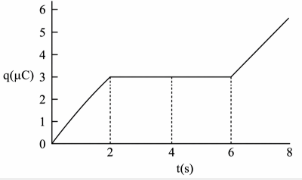
First, recall the fundamental relation between current and charge. The electric current $$I$$ through any conductor (or here, through the leads of the capacitor) is defined as the time‐rate of change of charge $$q$$ flowing past a given point. Mathematically, the definition is
$$I \;=\;\dfrac{dq}{dt}$$
We are given a graph of charge on the capacitor plate as a function of time. The question asks for the value of the current at the particular instant $$t = 4\;\text{s}$$. From the definition above, this current is nothing but the slope of the $$q$$-versus-$$t$$ curve at that instant.
Now, observe the portion of the graph that covers the interval from $$t = 3\;\text{s}$$ to $$t = 5\;\text{s}$$. In this stretch, the plotted charge remains perfectly horizontal, indicating that the value of charge does not change with time. Expressed algebraically, during this interval we have
$$q(t) = \text{constant}$$
Since the function is constant, its derivative with respect to time is zero:
$$\dfrac{dq}{dt} = 0$$
Substituting this derivative back into the current definition, we obtain
$$I = \dfrac{dq}{dt} = 0$$
Hence, at $$t = 4\;\text{s}$$—which lies squarely in the mentioned flat region—the current through the circuit is zero.
Hence, the correct answer is Option C.
Was this solution helpful?

Click on the Email ☝️ to Watch the Video Solution
Create a FREE account and get:
_1.webp)

Educational materials for JEE preparation

Ask our AI anything

AI can make mistakes. Please verify important information.
AI can make mistakes. Please verify important information.


