
Join Our JEE Preparation Group
Prep with like-minded aspirants; Get access to free daily tests and study material.
Sign in
Please select an account to continue using cracku.in
↓ →
Join Our JEE Preparation Group
Prep with like-minded aspirants; Get access to free daily tests and study material.
A particle of mass 4M at rest disintegrates into two particles of mass M and 3M, respectively, having non zero velocities. The ratio of de-Broglie wavelength of particle of mass M to that of mass 3M will be:
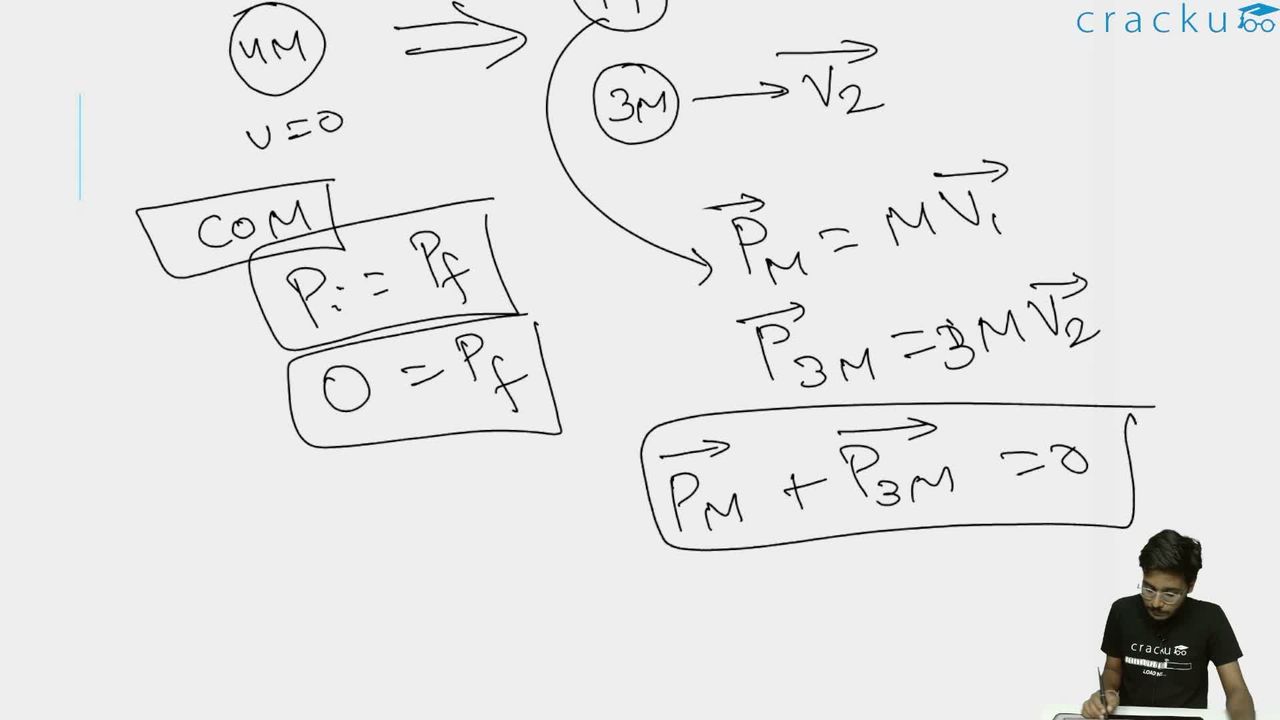
We have a single particle whose initial mass is $$4M$$ and it is stated to be at rest. “At rest’’ means that its initial linear momentum is zero, i.e. $$\vec p_{\text{initial}} = 0$$.
This particle suddenly disintegrates into two separate particles. The first fragment has mass $$M$$ and the second fragment has mass $$3M$$. Let their velocities after disintegration be $$\vec v_1$$ (for the particle of mass $$M$$) and $$\vec v_2$$ (for the particle of mass $$3M$$). Because the original body was isolated and at rest, the law of conservation of linear momentum must hold.
Conservation of momentum (statement). For an isolated system, the vector sum of the momenta before and after any internal interaction remains unchanged.
Applying this law, we write
$$M\,\vec v_1 \;+\; 3M\,\vec v_2 \;=\; \vec 0.$$
We now proceed algebraically, isolating one velocity in terms of the other. Dividing every term by the common factor $$M$$ gives
$$\vec v_1 \;+\; 3\,\vec v_2 \;=\; \vec 0.$$
Rearranging, we get
$$\vec v_1 \;=\; -\,3\,\vec v_2.$$
This result tells us that the two velocities are in opposite directions (the minus sign) and that the magnitude of $$\vec v_1$$ is three times the magnitude of $$\vec v_2$$:
$$|\vec v_1| \;=\; 3\,|\vec v_2|.$$
Next, we write the individual momenta after the disintegration:
First particle (mass $$M$$): $$\vec p_1 \;=\; M\,\vec v_1.$$
Second particle (mass $$3M$$): $$\vec p_2 \;=\; 3M\,\vec v_2.$$
We take magnitudes to compare them. Using $$|\vec v_1| = 3\,|\vec v_2|$$, we have
$$|\vec p_1| \;=\; M\,|\vec v_1| \;=\; M\,(3\,|\vec v_2|) \;=\; 3M\,|\vec v_2|.$$
Similarly,
$$|\vec p_2| \;=\; 3M\,|\vec v_2|.$$
From the last two lines we observe
$$|\vec p_1| = |\vec p_2|.$$
Thus, although the particles have different masses and different speeds, the magnitudes of their linear momenta are identical, fulfilling momentum conservation.
Now we invoke the de-Broglie relation.
de-Broglie wavelength formula. The wavelength associated with a particle of momentum $$p$$ is
$$\lambda = \dfrac{h}{p},$$
where $$h$$ is Planck’s constant.
Let $$\lambda_1$$ be the wavelength of the particle of mass $$M$$ and $$\lambda_2$$ be that of the particle of mass $$3M$$. Then
$$\lambda_1 = \dfrac{h}{|\vec p_1|}, \qquad \lambda_2 = \dfrac{h}{|\vec p_2|}.$$
We now form the required ratio:
$$\dfrac{\lambda_1}{\lambda_2} = \dfrac{h/|\vec p_1|}{\,h/|\vec p_2|\,} = \dfrac{|\vec p_2|}{|\vec p_1|}.$$
But we have already shown that $$|\vec p_1| = |\vec p_2|$$, so
$$\dfrac{\lambda_1}{\lambda_2} = 1.$$
This translates to the numerical ratio
$$\lambda_1 : \lambda_2 = 1 : 1.$$
Hence, the correct answer is Option D.
Was this solution helpful?
Click on the Email ☝️ to Watch the Video Solution
Create a FREE account and get:
_1.webp)

Educational materials for JEE preparation

Ask our AI anything

AI can make mistakes. Please verify important information.
AI can make mistakes. Please verify important information.
