
Join Our JEE Preparation Group
Prep with like-minded aspirants; Get access to free daily tests and study material.
Sign in
Please select an account to continue using cracku.in
↓ →
Join Our JEE Preparation Group
Prep with like-minded aspirants; Get access to free daily tests and study material.
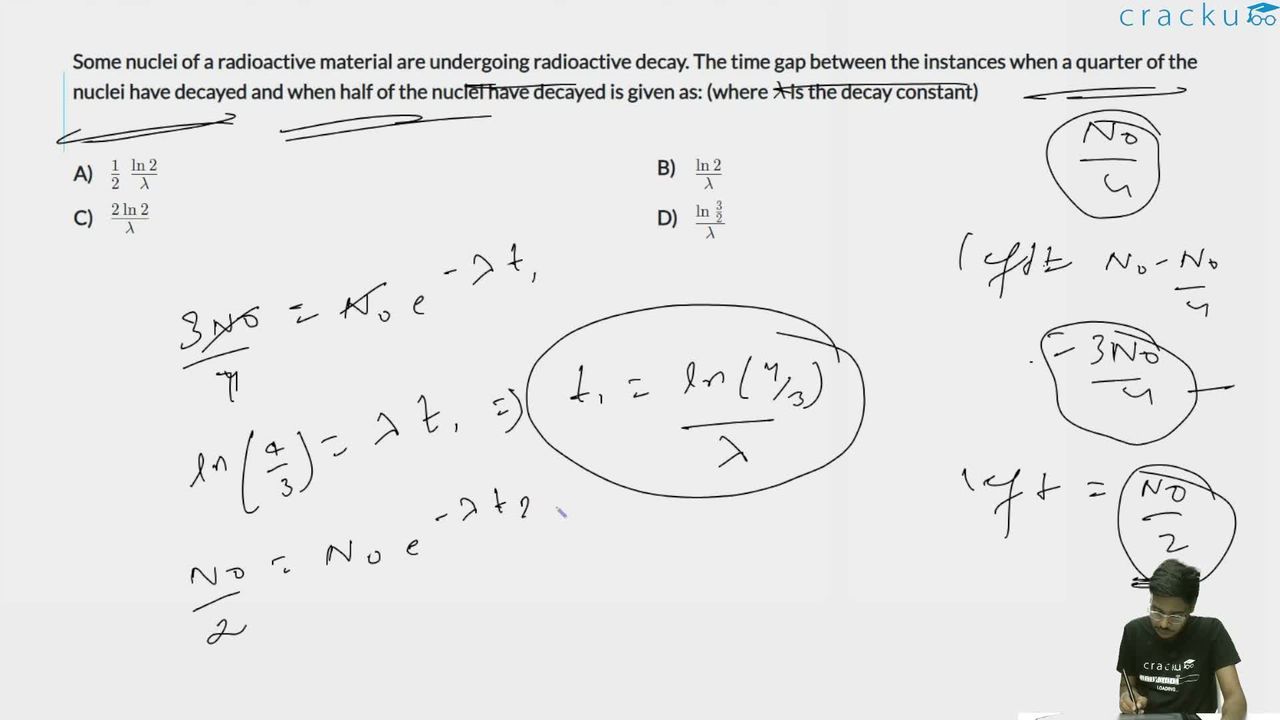
Some nuclei of a radioactive material are undergoing radioactive decay. The time gap between the instances when a quarter of the nuclei have decayed and when half of the nuclei have decayed is given as: (where $$\lambda$$ is the decay constant)
We begin with the radioactive-decay law, which states that the number of undecayed nuclei present at any time $$t$$ is
$$N(t)=N_0\,e^{-\lambda t},$$
where $$N_0$$ is the initial number of nuclei and $$\lambda$$ is the decay constant.
First we locate the instant when exactly one-quarter of the original nuclei have decayed. If one-quarter (that is, $$\dfrac14$$) have disappeared, then three-quarters (that is, $$\dfrac34$$) are still present. Hence, at this instant (let us call the time $$t_1$$) we have
$$N(t_1)=\frac34\,N_0.$$
Substituting this in the decay law gives
$$\frac34\,N_0 \;=\; N_0\,e^{-\lambda t_1}.$$
We can cancel the common factor $$N_0$$ on both sides:
$$\frac34 \;=\; e^{-\lambda t_1}.$$
Now we take the natural logarithm (ln) of both sides. Using the algebraic fact $$\ln e^x = x,$$ we get
$$\ln\!\left(\frac34\right) \;=\; -\lambda t_1.$$
Solving for $$t_1$$ gives
$$t_1 \;=\; -\frac1\lambda\,\ln\!\left(\frac34\right) \;=\; \frac1\lambda\,\ln\!\left(\frac43\right).$$
Next we locate the instant when exactly one-half of the nuclei have decayed. If one-half have disappeared, the remaining fraction is $$\dfrac12$$. Let the corresponding time be $$t_2$$. Thus
$$N(t_2)=\frac12\,N_0.$$
Again substituting in the decay law, we write
$$\frac12\,N_0 \;=\; N_0\,e^{-\lambda t_2}.$$
Cancelling $$N_0$$ yields
$$\frac12 \;=\; e^{-\lambda t_2}.$$
Taking natural logarithms once more:
$$\ln\!\left(\frac12\right) \;=\; -\lambda t_2.$$
Therefore,
$$t_2 \;=\; -\frac1\lambda\,\ln\!\left(\frac12\right) \;=\; \frac1\lambda\,\ln 2.$$
The required quantity is the time gap between these two instants, i.e.,
$$\Delta t=t_2-t_1.$$
Substituting the expressions for $$t_2$$ and $$t_1$$, we obtain
$$\Delta t \;=\; \frac1\lambda\,\ln 2 \;-\; \frac1\lambda\,\ln\!\left(\frac43\right).$$
Factoring out the common factor $$\dfrac1\lambda$$:
$$\Delta t \;=\; \frac1\lambda\left[\ln 2 - \ln\!\left(\frac43\right)\right].$$
By the logarithm subtraction rule $$\ln a - \ln b = \ln\!\left(\dfrac{a}{b}\right),$$ this simplifies to
$$\Delta t \;=\; \frac1\lambda\,\ln\!\left(\frac{2}{\frac43}\right).$$
Simplifying the fraction inside the logarithm:
$$\frac{2}{\frac43} \;=\; 2 \times \frac34 \;=\; \frac32.$$
Thus,
$$\Delta t \;=\; \frac1\lambda\,\ln\!\left(\frac32\right).$$
So the time interval between the moment when a quarter of the nuclei have decayed and the moment when half of them have decayed is
$$\boxed{\displaystyle \frac{\ln\!\left(\frac32\right)}{\lambda}}.$$
Hence, the correct answer is Option D.
Was this solution helpful?
Click on the Email ☝️ to Watch the Video Solution
Create a FREE account and get:
_1.webp)

Educational materials for JEE preparation

Ask our AI anything

AI can make mistakes. Please verify important information.
AI can make mistakes. Please verify important information.
