
Join Our JEE Preparation Group
Prep with like-minded aspirants; Get access to free daily tests and study material.
Sign in
Please select an account to continue using cracku.in
↓ →
Join Our JEE Preparation Group
Prep with like-minded aspirants; Get access to free daily tests and study material.
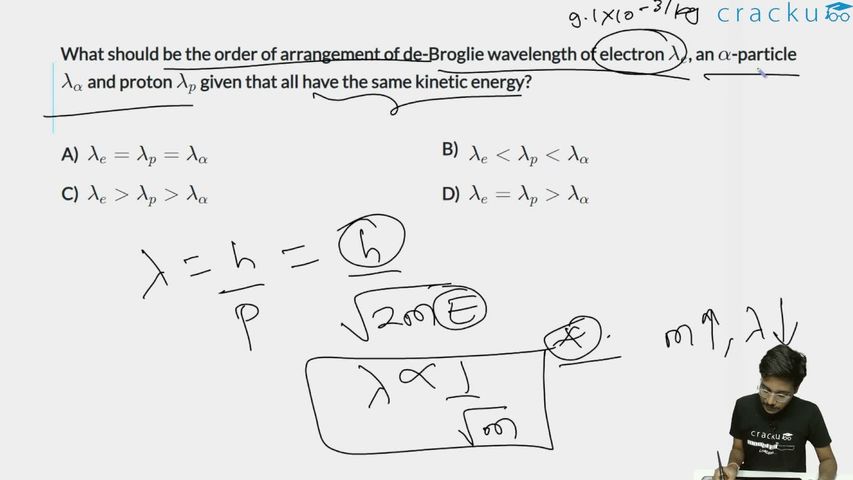
What should be the order of arrangement of de-Broglie wavelength of electron $$\lambda_e$$, an $$\alpha$$-particle $$\lambda_\alpha$$ and proton $$\lambda_p$$ given that all have the same kinetic energy?
We begin with the de-Broglie relation, which connects the wavelength $$\lambda$$ of a particle with its linear momentum $$p$$:
$$\lambda \;=\; \frac{h}{p},$$
where $$h$$ is Planck’s constant.
All the three particles mentioned—electron, proton and $$\alpha$$-particle—are said to possess the same kinetic energy. For a non-relativistic particle, the kinetic energy $$K$$ and the momentum $$p$$ are related through the familiar formula from elementary mechanics:
$$K \;=\; \frac{p^{2}}{2m},$$
where $$m$$ denotes the mass of the particle. We now solve this expression for the momentum $$p$$ because the de-Broglie wavelength depends directly on $$p$$.
Multiplying both sides by $$2m$$ gives
$$2mK \;=\; p^{2}.$$
Taking the positive square root (momentum magnitude) on both sides, we get
$$p \;=\; \sqrt{\,2mK\,}.$$
We now substitute this explicit form of $$p$$ into the de-Broglie relation:
$$\lambda \;=\; \frac{h}{p} \;=\; \frac{h}{\sqrt{\,2mK\,}}.$$
Because all three particles are given to have the same kinetic energy $$K$$, the symbols $$h$$ and $$K$$ are identical for each. Therefore, the only variable determining the relative size of the wavelength is the mass $$m$$ present under the square root in the denominator.
Let us state this dependence clearly:
$$\lambda \,\propto\, \frac{1}{\sqrt{m}}.$$
That is, the de-Broglie wavelength is inversely proportional to the square root of the particle’s mass. A smaller mass yields a larger wavelength, and a larger mass yields a smaller wavelength.
Now we list the approximate masses of the three particles involved:
• Electron mass: $$m_e \approx 9.1 \times 10^{-31}\ \text{kg}.$$
• Proton mass: $$m_p \approx 1.67 \times 10^{-27}\ \text{kg}.$$
• $$\alpha$$-particle mass: $$m_\alpha \approx 4\,m_p \approx 6.68 \times 10^{-27}\ \text{kg}.$$
Plainly,
$$m_e \;<\; m_p \;<\; m_\alpha.$$
Because the wavelength varies as the inverse square root of the mass, the inequality in wavelengths runs in the opposite sense:
$$\lambda_e \;>\; \lambda_p \;>\; \lambda_\alpha.$$
Translating this into the order requested, we have
$$\lambda_e \;>\; \lambda_p \;>\; \lambda_\alpha.$$
Among the given choices, this ordering corresponds precisely to Option C.
Hence, the correct answer is Option C.
Was this solution helpful?
Click on the Email ☝️ to Watch the Video Solution
Create a FREE account and get:
_1.webp)

Educational materials for JEE preparation

Ask our AI anything

AI can make mistakes. Please verify important information.
AI can make mistakes. Please verify important information.
