
Join Our JEE Preparation Group
Prep with like-minded aspirants; Get access to free daily tests and study material.
Sign in
Please select an account to continue using cracku.in
↓ →
Join Our JEE Preparation Group
Prep with like-minded aspirants; Get access to free daily tests and study material.
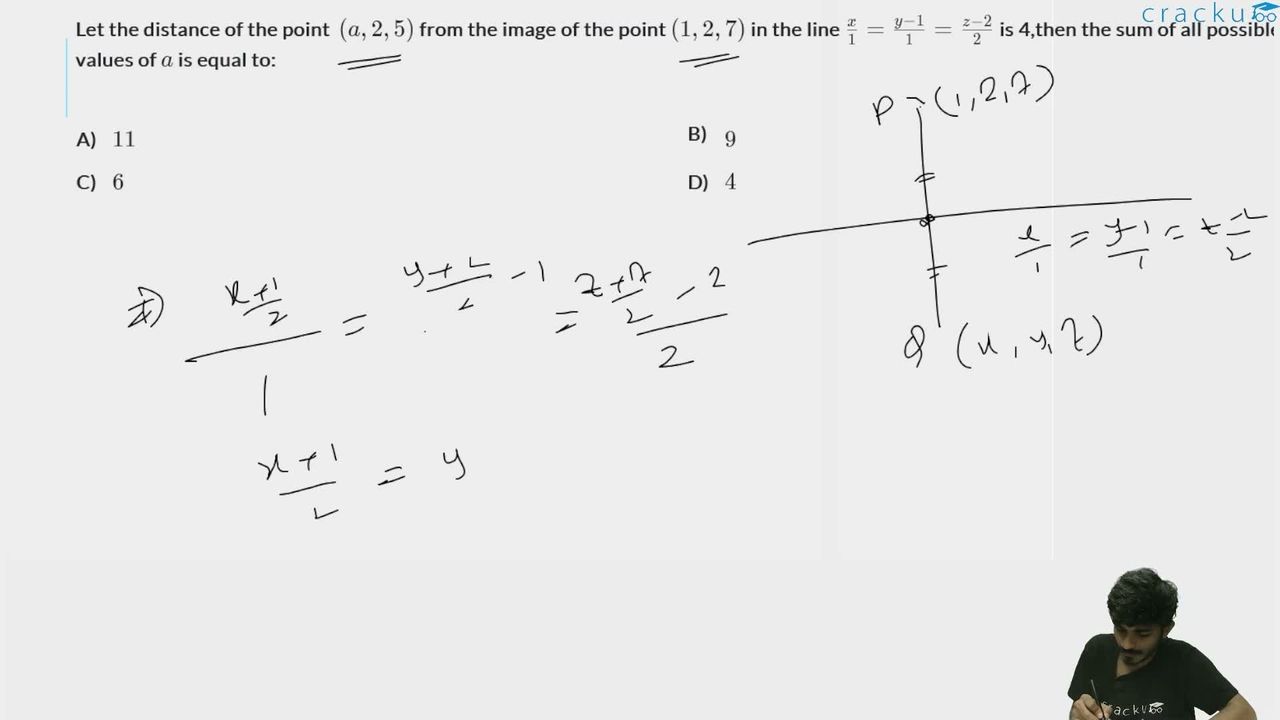
Let the distance of the point $$(a, 2, 5)$$ from the image of the point $$(1, 2, 7)$$ in the line $$\frac{x}{1} = \frac{y-1}{1} = \frac{z-2}{2}$$ is 4,then the sum of all possible values of $$a$$ is equal to:
$$\frac{x}{1} = \frac{y-1}{1} = \frac{z-2}{2} = \lambda$$
Any general point $$M$$ on this line can be written in terms of $$\lambda$$: $$M = (\lambda, \lambda + 1, 2\lambda + 2)$$
The direction ratios (DRs) of the given line are: $$\vec{d} = (1, 1, 2)$$
The direction ratios of the line segment $$PM$$ are: $$\text{DRs of } PM = (\lambda - 1, (\lambda + 1) - 2, (2\lambda + 2) - 7) = (\lambda - 1, \lambda - 1, 2\lambda - 5)$$
Since $$PM$$ is perpendicular to the line, the dot product of their direction ratios must be zero:
$$1(\lambda - 1) + 1(\lambda - 1) + 2(2\lambda - 5) = 0$$
$$\lambda - 1 + \lambda - 1 + 4\lambda - 10 = 0$$
$$6\lambda - 12 = 0 \implies \lambda = 2$$
$$M = (2, 2 + 1, 2(2) + 2) = (2, 3, 6)$$
The foot of the perpendicular $$M(2, 3, 6)$$ is the midpoint of the line segment joining the point $$P(1, 2, 7)$$ and its image $$P'(x_1, y_1, z_1)$$:
$$2 = \frac{1 + x_1}{2} \implies x_1 = 3$$
$$3 = \frac{2 + y_1}{2} \implies y_1 = 4$$
$$6 = \frac{7 + z_1}{2} \implies z_1 = 5$$
So, the image point is $$P'(3, 4, 5)$$.
The distance between the point $$(a, 2, 5)$$ and the image point $$P'(3, 4, 5)$$ is given as $$4$$:
$$\sqrt{(a - 3)^2 + (2 - 4)^2 + (5 - 5)^2} = 4$$
$$(a - 3)^2 + (-2)^2 + 0^2 = 16$$
$$(a - 3)^2 = 12$$
$$a = 3 \pm 2\sqrt{3}$$
$$\text{Sum} = (3 + 2\sqrt{3}) + (3 - 2\sqrt{3}) = 6$$
Click on the Email ☝️ to Watch the Video Solution
Create a FREE account and get:
_1.webp)

Educational materials for JEE preparation

Ask our AI anything

AI can make mistakes. Please verify important information.
AI can make mistakes. Please verify important information.


