
Join Our JEE Preparation Group
Prep with like-minded aspirants; Get access to free daily tests and study material.
Sign in
Please select an account to continue using cracku.in
↓ →
Join Our JEE Preparation Group
Prep with like-minded aspirants; Get access to free daily tests and study material.
In the given circuit the AC source has $$\omega = 100$$ rad s$$^{-1}$$. Considering the inductor and capacitor to be ideal, what will be the current $$I$$ flowing through the circuit?
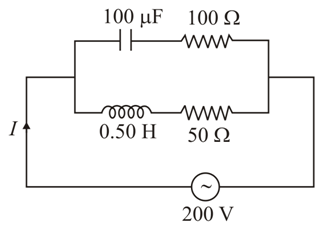
We need to determine the total rms current $$I$$ flowing through the given parallel alternating current (AC) circuit arrangement.
From the problem, the parallel circuit consists of two parallel branches connected across an AC voltage source of $$V_{\text{rms}} = 200\text{ V}$$ with an angular frequency of $$\omega = 100\text{ rad s}^{-1}$$:
We first calculate the capacitive reactance ($$X_C$$) and inductive reactance ($$X_L$$), followed by the total impedance of each path:
$$X_C = \frac{1}{\omega C} = \frac{1}{100 \times 100 \times 10^{-6}} = 100\ \Omega$$
The impedance ($$Z_1$$) of the series RC branch is:$$Z_1 = \sqrt{R_1^2 + X_C^2} = \sqrt{100^2 + 100^2} = 100\sqrt{2}\ \Omega \approx 141.42\ \Omega$$
$$X_L = \omega L = 100 \times 0.50 = 50\ \Omega$$
The impedance ($$Z_2$$) of the series RL branch is:$$Z_2 = \sqrt{R_2^2 + X_L^2} = \sqrt{50^2 + 50^2} = 50\sqrt{2}\ \Omega \approx 70.71\ \Omega$$
The voltage drop across both parallel branches is equal to the source voltage ($$V_{\text{rms}} = 200\text{ V}$$):
$$I_1 = \frac{V_{\text{rms}}}{Z_1} = \frac{200}{100\sqrt{2}} = \sqrt{2}\text{ A} \approx 1.414\text{ A}$$
Since it is an RC circuit, the current leads the voltage by a phase angle of $$\phi_1 = \tan^{-1}\left(\frac{X_C}{R_1}\right) = \tan^{-1}(1) = +45^\circ$$.$$I_2 = \frac{V_{\text{rms}}}{Z_2} = \frac{200}{50\sqrt{2}} = 2\sqrt{2}\text{ A} \approx 2.828\text{ A}$$
Since it is an RL circuit, the current lags behind the voltage by a phase angle of $$\phi_2 = \tan^{-1}\left(\frac{X_L}{R_2}\right) = \tan^{-1}(1) = -45^\circ$$.The net phase difference between the leading branch current ($$I_1$$) and lagging branch current ($$I_2$$) is $$\Delta\phi = 45^\circ - (-45^\circ) = 90^\circ$$. Because the two current vectors are perpendicular (in quadrature), their phasor sum can be evaluated using the Pythagorean theorem:
$$I = \sqrt{I_1^2 + I_2^2}$$
$$I = \sqrt{(\sqrt{2})^2 + (2\sqrt{2})^2} = \sqrt{2 + 8} = \sqrt{10}\text{ A}$$
$$I \approx 3.16\text{ A}$$
The total current flowing through the AC circuit configuration is 3.16 A.
Was this solution helpful?
Create a FREE account and get:
_1.webp)

Educational materials for JEE preparation

Ask our AI anything

AI can make mistakes. Please verify important information.
AI can make mistakes. Please verify important information.
