
Join Our JEE Preparation Group
Prep with like-minded aspirants; Get access to free daily tests and study material.
Sign in
Please select an account to continue using cracku.in
↓ →
Join Our JEE Preparation Group
Prep with like-minded aspirants; Get access to free daily tests and study material.
The angular frequency of alternating current in a L-C-R circuit is 100 rad s$$^{-1}$$. The components connected are shown in the figure. Find the value of inductance of the coil and capacity of condenser.
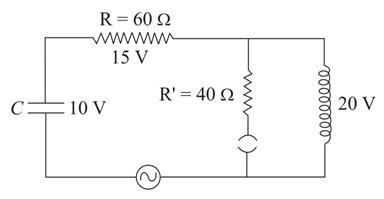
From the given figure, we can observe the values for the top horizontal branch:
Since the alternating components share the same series current network loop, we can apply Ohm's Law across this specific resistor to find the RMS current ($$I$$) flowing through the entire circuit:
$$I = \frac{V_R}{R} = \frac{15 \,\, \text{V}}{60 \,\, \Omega} = 0.25 \,\, \text{A}$$
From the diagram, the potential drop across the inductor is $$V_L = 20 \,\, \text{V}$$. The inductive reactance ($$X_L$$) can be expressed as:
$$V_L = I \cdot X_L \implies X_L = \frac{V_L}{I}$$
$$X_L = \frac{20 \,\, \text{V}}{0.25 \,\, \text{A}} = 80 \,\, \Omega$$
We know that inductive reactance is related to the angular frequency ($$\omega = 100 \,\, \text{rad s}^{-1}$$) and inductance ($$L$$) by the formula $$X_L = \omega L$$:
L = $$\frac{X_L}{\omega}$$ = $$\frac{80}{100} = 0.8 \,\, \text{H}$$
From the diagram, the potential drop across the capacitor is $$V_C = 10 \,\, \text{V}$$. The capacitive reactance ($$X_C$$) is given by:
$$V_C = I \cdot X_C \implies X_C = \frac{V_C}{I}$$
$$X_C = \frac{10 \,\, \text{V}}{0.25 \,\, \text{A}} = 40 \,\, \Omega$$
The relationship between capacitive reactance, angular frequency ($$\omega$$), and capacitance ($$C$$) is defined by $$X_C = \frac{1}{\omega C}$$:
$$C = \frac{1}{\omega \cdot X_C} = \frac{1}{100 \times 40} = \frac{1}{4000} \,\, \text{F}$$
To convert Farads into microfarads ($$\mu\text{F}$$), multiply the result by $$10^6$$:
$$C = \frac{10^6}{4000} \,\, \mu\text{F} = \frac{1000}{4} \,\, \mu\text{F} = 250 \,\, \mu\text{F}$$
Correct Option: D ($$0.8 \,\, \text{H and } 250 \,\, \mu\text{F}$$)
```
Was this solution helpful?
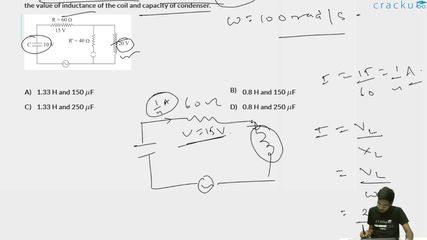
Click on the Email ☝️ to Watch the Video Solution
Create a FREE account and get:
_1.webp)

Educational materials for JEE preparation

Ask our AI anything

AI can make mistakes. Please verify important information.
AI can make mistakes. Please verify important information.
