
Join Our JEE Preparation Group
Prep with like-minded aspirants; Get access to free daily tests and study material.
Sign in
Please select an account to continue using cracku.in
↓ →
Join Our JEE Preparation Group
Prep with like-minded aspirants; Get access to free daily tests and study material.
$$\text{The function }f:(-\infty,\infty)\to(-\infty,1), \text{ defined by }f(x)=\frac{2^x-2^{-x}}{2^x+2^{-x}}\text{ is:}$$
We need to determine whether $$f(x) = \frac{2^x - 2^{-x}}{2^x + 2^{-x}}$$ is one-one and/or onto.
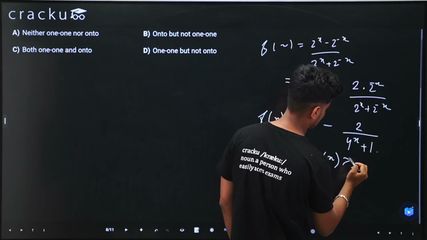
Since we can set $$u = 2^x$$, it follows that $$f(x) = \frac{u - 1/u}{u + 1/u} = \frac{u^2 - 1}{u^2 + 1}$$. Also, this can be written as $$f(x) = \tanh(x\ln 2)$$, which is a scaled hyperbolic tangent function.
Substituting the derivative perspective, one finds $$f(x) = 1 - \frac{2}{u^2+1} = 1 - \frac{2}{2^{2x}+1}$$. As $$x$$ increases, $$2^{2x}$$ increases so that $$\frac{2}{2^{2x}+1}$$ decreases, implying that $$f(x)$$ increases. Alternatively, the derivative of $$\tanh(x\ln 2)$$ is always positive for all real $$x$$. Therefore, $$f$$ is strictly increasing and hence one-one.
As $$x \to +\infty$$, $$2^x \to \infty$$ and $$2^{-x} \to 0$$, so $$f(x) \to \frac{\infty}{\infty} = 1$$ (approaching from below). As $$x \to -\infty$$, $$2^x \to 0$$ and $$2^{-x} \to \infty$$, so $$f(x) \to \frac{-\infty}{\infty} = -1$$ (approaching from above). At $$x = 0$$, $$f(0) = \frac{1-1}{1+1} = 0$$. This gives the range of $$f$$ as $$(-1, 1)$$.
Since the codomain is given as $$(-\infty, 1)$$ and $$(-1, 1)$$ is a proper subset of $$(-\infty, 1)$$, the function is not onto.
The correct answer is Option 4: One-one but not onto.
Was this solution helpful?
Click on the Email ☝️ to Watch the Video Solution
Create a FREE account and get:
_1.webp)

Educational materials for JEE preparation

Ask our AI anything

AI can make mistakes. Please verify important information.
AI can make mistakes. Please verify important information.
