
Join Our JEE Preparation Group
Prep with like-minded aspirants; Get access to free daily tests and study material.
Sign in
Please select an account to continue using cracku.in
↓ →
Join Our JEE Preparation Group
Prep with like-minded aspirants; Get access to free daily tests and study material.
The number of real solution(s) of the equation $$x^2 + 3x + 2 = \min\{|x-3|,|x+2|\}\text{ is:}$$
To solve this systematically, let's break down the Right Hand Side (RHS) first.
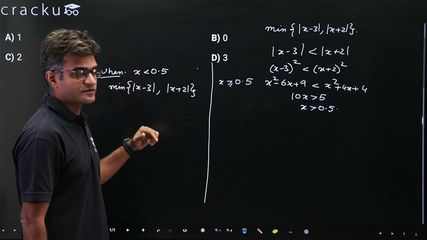
The function $$\min\{|x - 3|, |x + 2|\}$$ gives the smaller of the two distances from $$x$$ to $$3$$ and from $$x$$ to $$-2$$. The point where these distances are exactly equal is the midpoint:
$$x = \frac{3 + (-2)}{2} = 0.5$$
This allows us to redefine the RHS piecewise:
Now, split the original equation into these two main regions and solve.
The equation becomes: $$x^2 + 3x + 2 = |x + 2|$$
Since the absolute value changes behavior at $$x = -2$$, we check two sub-cases:
$$x^2 + 3x + 2 = -(x + 2)$$
$$x^2 + 4x + 4 = 0$$
$$(x + 2)^2 = 0 \implies x = -2$$
(Since $$-2 \le -2$$, this is a valid solution).
$$x^2 + 3x + 2 = +(x + 2)$$
$$x^2 + 2x = 0$$
$$x(x + 2) = 0 \implies x = 0 \text{ or } x = -2$$
(Since $$x = 0$$ falls within $$-2 < x \le 0.5$$, this is a valid solution).
The equation becomes: $$x^2 + 3x + 2 = |x - 3|$$
Again, split at the critical point $$x = 3$$:
$$x^2 + 3x + 2 = -(x - 3)$$
$$x^2 + 4x - 1 = 0$$
Using the quadratic formula: $$x = \frac{-4 \pm \sqrt{16 - 4(1)(-1)}}{2} = -2 \pm \sqrt{5}$$
Since $$\sqrt{5} \approx 2.23$$, the roots are roughly $$0.23$$ and $$-4.23$$. Neither of these falls in the interval $$(0.5, 3)$$.
(No solution here).
$$x^2 + 3x + 2 = +(x - 3)$$
$$x^2 + 2x + 5 = 0$$
Checking the discriminant: $$D = 2^2 - 4(1)(5) = -16$$
Since $$D < 0$$, there are no real roots.
(No solution here).
Conclusion:
The only valid real solutions are $$x = -2$$ and $$x = 0$$.
Therefore, the number of real solutions is 2.
Was this solution helpful?
Click on the Email ☝️ to Watch the Video Solution
Create a FREE account and get:
_1.webp)

Educational materials for JEE preparation

Ask our AI anything

AI can make mistakes. Please verify important information.
AI can make mistakes. Please verify important information.
