
Join Our JEE Preparation Group
Prep with like-minded aspirants; Get access to free daily tests and study material.
Sign in
Please select an account to continue using cracku.in
↓ →
Join Our JEE Preparation Group
Prep with like-minded aspirants; Get access to free daily tests and study material.
A conducting bar of length $$L$$ is free to slide on two parallel conducting rails as shown in the figure.
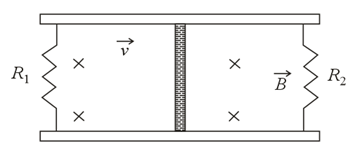
Two resistors $$R_1$$ and $$R_2$$ are connected across the ends of the rails. There is a uniform magnetic field $$\vec{B}$$ pointing into the page. An external agent pulls the bar to the left at a constant speed $$v$$. The correct statement about the directions of induced currents $$I_1$$ and $$I_2$$ flowing through $$R_1$$ and $$R_2$$ respectively is:
We need to determine the directions of the induced currents $$I_1$$ and $$I_2$$ flowing through the resistors $$R_1$$ and $$R_2$$ when a conducting bar is pulled to the left at a constant speed $$v$$ in a uniform magnetic field pointing into the page.
We can solve this problem using two well-established physics approaches: Lenz's Law and the Motional EMF (Right-Hand Rule) method.
Lenz's Law states that the direction of an induced current will always oppose the change in magnetic flux that produces it.
1. Left Loop containing Resistor $$R_1$$:
2. Right Loop containing Resistor $$R_2$$:
When the conducting rod moves through the magnetic field, the free charges inside the rod experience a magnetic Lorentz force given by $$\vec{F} = q(\vec{v} \times \vec{B})$$.
Now, tracing how this "battery" drives current through each parallel loop:
Both methods yield the same consistent result:
Therefore, the correct answer is Option C: $$I_1$$ is in clockwise direction and $$I_2$$ is in anticlockwise direction.
Click on the Email ☝️ to Watch the Video Solution
Create a FREE account and get:
_1.webp)

Educational materials for JEE preparation

Ask our AI anything

AI can make mistakes. Please verify important information.
AI can make mistakes. Please verify important information.


